The Process of Sound Travelling Through Air:
Topics
Force, Work, Power and Energy
Force
Light
Work, Energy and Power
- Concept of Work
- Measurement of Work
- Expression for Work (W = F S cosθ)
- Work Done by the Force of Gravity (W = mgh)
- Concept of Power
- Work vs Power
- Concept of Energy
- Energy vs Power
- Mechanical Energy > Potential Energy (U)
- Mechanical Energy > Kinetic Energy (K)
- Potential vs Kinetic Energy
- Conversion of Potential Energy into Kinetic Energy
- Forms of Energy > Solar Energy
- Forms of Energy > Heat Energy
- Forms of Energy > Light Energy
- Forms of Energy > Chemical Energy
- Forms of Energy > Hydro Energy
- Forms of Energy > Electrical Energy
- Forms of Energy > Nuclear Energy
- Forms of Energy > Geo Thermal Energy
- Forms of Energy > Wind Energy
- Forms of Energy > Sound Energy
- Forms of Energy > Magnetic Energy
- Forms of Energy > Mechanical Energy
- Conversion of Energies
- Principle of Conservation of Energy
- Proof: Kinetic + Potential Energy = Constant for Free Fall
- Application of the Principle of Conservation of Energy
Machines
- Concept of Machines
- Technical Terms Related to a Machine
- Principle of a Machine
- Efficiency, Mechanical Advantage, and Velocity Ratio
- Levers
- Types of Levers
- Pulley
- Single Fixed Pulley
- A Single Movable Pulley
- Single Pulley vs Single Movable Pulley
- Combination of Pulleys
- Using one fixed pulley and other movable pulleys
- Using several pulleys in two blocks (block and tackle system)
Sound
Electricity and Magnetism
Refraction of Light at Plane Surfaces
- Light: Reflection and Refraction
- Refraction of Light
- Laws of Refraction
- Speed of Light in Different Media
- Principle of Reversibility of the Path of Light
- Refraction Laws & Glass Index
- Refraction of Light Through a Rectangular Glass Block
- Multiple Images in a Thick Mirror
- Prism
- Refraction of Light through a Prism
- Real and Apparent Depth
- Apparent Bending of a Stick Under Water
- Consequences of Refraction of Light
- Transmission of Light From a Denser Medium to a Rarer Medium
- Critical Angle
- Relationship between Critical Angle and Refractive Index
- Total Internal Reflection
- Total Internal Reflection in a Prism
- Total Internal Reflection Through a Right-Angled Isosceles Prism
- Total Internal Reflection Through an Equilateral Prism
- Total Internal Reflection Through Right-angled prism
- Use of a Total Internal Reflecting Prism in Place of a Plane Mirror
- Total Internal Reflection vs Reflecting from a Plane Mirror
- Consequences of Total Internal Refraction
Heat
Refraction Through a Lens
- Concept of Lenses
- Action of a Lens as a Set of Prisms
- Technical Terms Related to a Lens
- Convex Lens vs Concave Lens
- Refraction of Light Through an Equi-Convex Lens and an Equi-Concave Lens
- Principal Rays for Ray Diagrams
- Real Image vs Virtual Image
- Construction of a Ray Diagram for a Lens
- Images Formed by Convex Lenses
- Images Formed by Concave Lenses
- Sign Convention
- Lens Formula and Magnification
- Linear Magnification
- Power of a Lens
- Magnifying Glass Or Simple Microscope
- Application of Lenses
- Experimental Determination of Focal Length of Convex Lens
- Convex Lens vs Concave Lens
Spectrum
- Deviation Produced by a Triangular Prism
- Colour in White Light with Their Wavelength and Frequency Range
- Dispersion of Light Through a Prism
- Electromagnetic Spectrum
- Properties and Uses of Different Radiations of the Electromagnetic Spectrum
- Distinction between Ultraviolet, Visible, and Infrared Radiations
- Scattering of Light-Rayleigh's Law
- Applications of Scattering of Light
Modern Physics
Sound
- Sound Waves
- Light Waves vs Sound Waves
- Reflection of Sound Waves
- Echo
- Determination of Speed of Sound by the Method of Echo
- Use of Echoes
- Natural Vibrations
- Damped Vibrations
- Natural Vibrations vs Damped Vibrations
- Forced Vibrations
- Natural Vibrations vs Forced Vibrations
- Resonance (a special case of forced vibrations)
- Demonstration of Resonance
- Forced Vibrations vs Resonant Vibrations
- Examples of Resonance
- Characteristics of Sound
- Loudness and Intensity
- Pitch and frequency
- Quality and Wave Form
- Music and Noise
Current Electricity
- Electric Charges
- Electric Current
- Potential Difference
- Electric Resistance
- Ohm's Law
- Experimental Verification of Ohm’s Law and Ohmic Resistors
- Ohmic and Non-ohmic Resistors
- Specific Resistance or Electrical Resistivity
- Choice of Material of a Wire
- Superconductors
- Electromotive Force of a Cell
- Terminal Voltage of a Cell
- Internal Resistance of a Cell
- Resistance of a System of Resistors
- Resistors in Series
- Resistors in Parallel
- Forms of Energy > Electrical Energy
- Measurement of Electrical Energy
- Electrical Power
- Commercial Unit of Electrical Energy
- Power Rating of Common Electrical Appliances
- Household Consumption of Electric Energy
- Heating Effect of Electric Current
Household Circuits
- Transmission of Power from the Power Generating Station to the Consumer
- Power Distribution to a House
- House Wiring (Ring System)
- Fuse
- Reason for connecting the fuse in the live wire
- Current Rating of a Fuse
- Switches
- Circuits with Dual Control Switches (Staircase Wire)
- Earthing
- Three-pin Plug and Socket
- Colour Coding of Wires in a Cable
- High Tension Wires
- Precautions to Be Taken While Using Electricity
Electro-Magnetism
- Oersted's Experiment
- Applications of Biot-Savart's Law > Magnetic Field Due to a Straight Current-carrying Conductor of Finite Size
- Right-hand Thumb Rule
- Applications of Biot-Savart's Law > Magnetic Field at the Axis of a Circular Current-carrying Loop
- Applications of Ampere’s Circuital Law > Magnetic Field of a Long Straight Solenoid
- Electromagnet
- Permanent Magnet
- Comparison of an Electro Magnet with a Permanent Magnet
- Advantages of an Electromagnet over a Permanent Magnet
- Uses of Electromagnet
- Force on a Current-Carrying Conductor Placed in a Uniform Magnetic Field
- Simple D.C. Motor
- Introduction to Electromagnetic Induction
- Electromagnetic Induction: Experimental Demonstration
- Faraday's Explanation
- Faraday's Laws of Electromagnetic Induction
- Alternating-Current Generator
- Frequency of an a.c. in Household Supplies
- Comparison Between A.C. Generator and D.C. Motor
- Transformers
Calorimetry
- Heat
- The Temperature and a Thermometer
- Factors Affecting the Quantity of Heat Absorbed to Increase the Temperature of a Body
- Heat vs Temperature
- Thermal or Heat Capacity
- Specific Heat Capacity
- Heat Capacity vs Specific Heat Capacity
- Specific Heat Capacity of Some Common Substances
- Calorimetry
- Principle of Method of Mixtures or Principle of Calorimetry
- Natural Phenomena and Consequences of High Specific Heat Capacity of Water
- Examples of High and Low Heat Capacity
- Change of State
- Melting and Freezing
- Melting Point and Its Effects
- Vaporisation or Boiling
- Boiling Point and Its Effects
- Latent Heat
- Specific Latent Heat of Fusion of Ice
- Explanation of Latent Heat of Melting based on Kinetic Model
- Natural Consequences of High Specific Latent Heat of Fusion of Ice
Radioactivity
- Structure of the Atom and Nucleus
- Atomic Models
- Isotopes
- Isobars
- Isotones
- Radioactivity
- Radioactivity as emission of Alpha, Beta, and Gamma Radiations
- Properties of Alpha Particles
- Properties of Beta Particles
- Properties of Gamma Radiations
- Distinction between the Properties of α, β, and γ Radiations
- Changes Within the Nucleus in Alpha, Beta and Gamma Emission
- Uses of Radioactive Isotopes
- Sources of Harmful Radiations
- Harmful Effects of Radiation
- Safety Precautions While Using Nuclear Energy
- Background Radiations
- Forms of Energy > Nuclear Energy
- Nuclear Fission
- Differences Between Radioactive Decay and Nuclear Fission
- Nuclear Fusion
- Difference between Nuclear Fusion and Neclear Fission
Estimated time: 16 minutes
Maharashtra State Board: Class 6
Introduction:
Sound is a type of energy that we can hear. It is produced when something vibrates, and these vibrations travel through the air to reach our ears. Our ears pick up sound vibrations and send signals to our brain. The brain then interprets these signals as different kinds of sounds.
- Loud sounds that can be heard easily, even from a distance. Examples include thunder, a car horn, or a drum.
- Soft sounds are gentle and quiet sounds that may be hard to hear unless we pay attention. Examples include the ticking of a clock or the rustling of leaves.
Maharashtra State Board: Class
Sound Waves:
A wave is a disturbance produced in a medium as the particles vibrate. The particles produce motion in each other without moving forward or backward, leading to sound propagation. Hence, the sound is often called a wave.
- When an object vibrates in the air or produces a sound, some regions of high pressure are created in front of it. These are called the Regions of Compression.
- These compression regions move forward in the medium as particles exert pressure on adjacent particles. With alternate regions of compression, there are also regions of low pressure in its front. These are called regions of rarefaction.
- As the object moves forwards and backwards consecutively, producing sound, a series of compressions and rarefactions will be created. This will also allow sound to move through air or any other medium.
- If the medium is dense, the pressure exerted on the particles will be greater to propagate the sound, and vice versa. Therefore, we can also say that sound propagation is all about a change in the pressure of the medium.
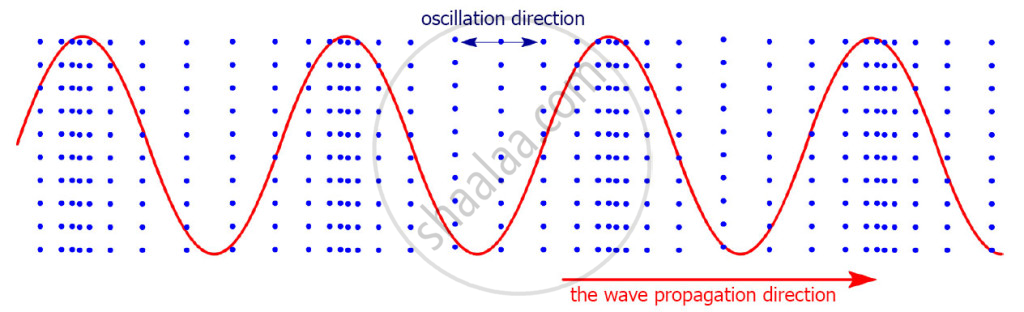
A wave produced when objects of the medium oscillate is called a mechanical wave. Sound cannot travel through the vacuum, as it always needs a medium to propagate. The vacuum contains no air; hence, no particles can propagate sound.
- Longitudinal waves: Any wave that vibrates in the direction of the motion is called a longitudinal wave. Sound waves are longitudinal because the particles of the medium vibrate in a direction parallel to the direction of the propagation of the sound waves. The particles in the medium oscillate to and fro in the case of longitudinal waves.
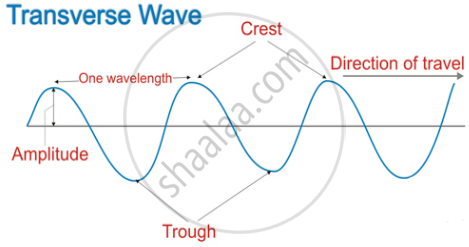
- Transverse Waves: A transverse wave is produced when the particles of the medium oscillate in a direction perpendicular to the direction of the propagation of the wave. The particles in a transverse wave oscillate in an up-and-down motion. For example, light waves are transverse in nature.
CISCE: Class 10
Definition: Audible Range of Frequency
Our ears are sensitive only to a limited range of frequencies from 20 Hz to 20,000 Hz, which is called the audible range of frequency.
CISCE: Class 10
Definition: Ultrasonic
The sound of frequency above 20,000 Hz is called ultrasonic.
CISCE: Class 10
Definition: Infrasonic
The sound of frequency below 20 Hz is called infrasonic.
CISCE: Class 10
Definition: Amplitude of the Wave
When a sound wave travels in a medium, the maximum displacement of the particle of the medium on either side of its mean position, is called the amplitude (a) of the wave.
CISCE: Class 10
Definition: Time Period of the Wave
The time taken by the particle of the medium to complete its one vibration, is called the time period (T) of the wave.
CISCE: Class 10
Definition: Frequency of the Wave
The number of vibrations made by the particle of the medium in one second, is called the frequency (j) of the wave.
CISCE: Class 10
Definition: Wavelength
The distance travelled by a wave in one time period of vibration of the particle of the medium, is called the wavelength (λ).
CISCE: Class 10
Definition: Wave Velocity
The distance travelled by the wave in one second is called the wave velocity (V).
Maharashtra State Board: Class 11
Definition: Wave
A pattern which moves through material medium by repeated vibration of the particles of the medium about their mean position without the actual movement of matter is called a wave.
Video Tutorials
Shaalaa.com | Longitudinal nature of sound
to track your progress
