Advertisements
Advertisements
प्रश्न
What adjustments would you make for tuning a stringed instrument for it to emit a note of a desired frequency?
Advertisements
उत्तर १
उत्तर २
The spot where the stretched string is plucked is altered as an adjustment.
-
We are aware that when a string is forced to vibrate, it produces transverse waves with varying amplitude and frequencies. These can be altered by adjusting the location at which the string is plucking.
- middle
- `1/4`th part of string
- `1/6` is the part of a string to produce the principal tone, first subsidiary or second subsidiary, respectively.
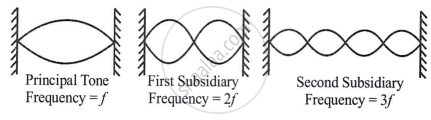
-
Moreover, FREQUENCY can be altered by adjusting the string's thickness. By twisting the pegs on a string, the tension can also be altered.
संबंधित प्रश्न
The displacement distance graph of two sound waves A and B, travelling in a medium, are as shown in the diagram below.
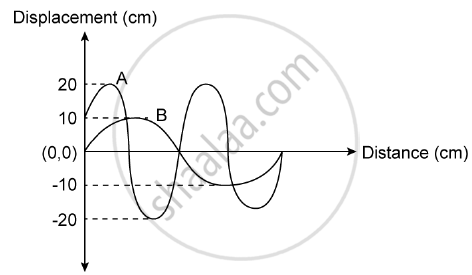
Study the two sound waves and compare their:
- Amplitudes
- Wavelengths
Define amplitude term in relation to a wave.
Define wavelength term in relation to a wave.
Define wave velocity term in relation to a wave.
Name the principle on which a soundboard works.
What is meant by echo depth sounding?
What do you understand by the ‘Echolocation system of Dolphins’?
A cork piece is floating on the surface of the water in a pond. A piece of pebble is dropped into the water. What will be your observation?
A radio signal, sent towards the surface of the moon, is received in 2.5 seconds. If the speed of the radio waves is 3 × 10⁸ ms−1, find the distance of the moon from the earth.
What is mean by the reflection of sound?
