Advertisements
Advertisements
प्रश्न
What adjustments would you make for tuning a stringed instrument for it to emit a note of a desired frequency?
Advertisements
उत्तर १
उत्तर २
The spot where the stretched string is plucked is altered as an adjustment.
-
We are aware that when a string is forced to vibrate, it produces transverse waves with varying amplitude and frequencies. These can be altered by adjusting the location at which the string is plucking.
- middle
- `1/4`th part of string
- `1/6` is the part of a string to produce the principal tone, first subsidiary or second subsidiary, respectively.
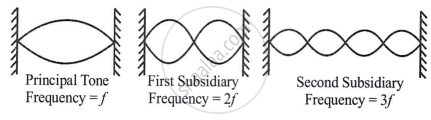
-
Moreover, FREQUENCY can be altered by adjusting the string's thickness. By twisting the pegs on a string, the tension can also be altered.
संबंधित प्रश्न
How is the frequency of a stretched string related it’s tension?
Name the characteristic of sound in relation to its waveform.
Name the principle on which a soundboard works.
Write the approximate value of the speed of sound in air.
What are fishing boats?
Explain why, the ceilings of concert halls are curved.
What is meant by an echo? Explain.
Write short notes on reflection of sound waves from plane and curved surfaces.
