Advertisements
Advertisements
Question
What adjustments would you make for tuning a stringed instrument for it to emit a note of a desired frequency?
Advertisements
Solution 1
Solution 2
The spot where the stretched string is plucked is altered as an adjustment.
-
We are aware that when a string is forced to vibrate, it produces transverse waves with varying amplitude and frequencies. These can be altered by adjusting the location at which the string is plucking.
- middle
- `1/4`th part of string
- `1/6` is the part of a string to produce the principal tone, first subsidiary or second subsidiary, respectively.
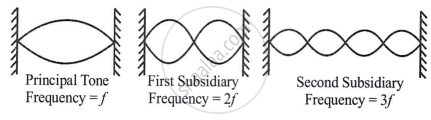
-
Moreover, FREQUENCY can be altered by adjusting the string's thickness. By twisting the pegs on a string, the tension can also be altered.
RELATED QUESTIONS
A certain sound has a frequency of 256 hertz and a wavelength of 1.3 m.
1) Calculate the speed with which this sound travels
2) What difference would be felt by a listener between the above sound and another sound traveling at the same speed, but of wavelength 2.6 m?
The displacement distance graph of two sound waves A and B, travelling in a medium, are as shown in the diagram below.
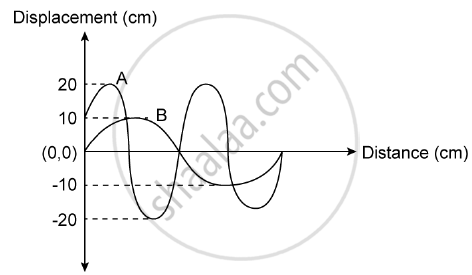
Study the two sound waves and compare their:
- Amplitudes
- Wavelengths
Explain how the principle of echo is used by the bat during its flight at night.
Write the approximate value of the speed of sound in iron.
Draw a diagram representing a wave of amplitude 4 cm and wavelength 2 m. If the frequency of the wave is 150 Hz, calculate its velocity.
A radio signal, sent towards the surface of the moon, is received in 2.5 seconds. If the speed of the radio waves is 3 × 10⁸ ms−1, find the distance of the moon from the earth.
What is meant by an echo? Explain.
The direction of the incident sound, the direction of reflected sound, and the normal are in different Planes.
