Advertisements
Advertisements
Question
Waves produced on the surface of the water are formed to move with a velocity of 24 ms−1. If the wavelength of these waves equals 20 cm. find the
(i) frequency (no. of waves produced per second)
(ii) the time period (i.e. the time required to produce one wave) for these waves.
Advertisements
Solution
(i) We have,
Wave velocity = Frequency × Wavelength
24 ms−1 = n × (20 × 10−2 m)
or n = `24/(24xx10^-2)` = 120 per second.
(ii) Time period = `1/"Frequency"=(1/120)"sec."` = 0.00833 sec.
The approximate frequency range of sound waves is about 15 to 200,000 Hz.
RELATED QUESTIONS
A certain sound has a frequency of 256 hertz and a wavelength of 1.3 m.
1) Calculate the speed with which this sound travels
2) What difference would be felt by a listener between the above sound and another sound traveling at the same speed, but of wavelength 2.6 m?
Name the characteristic of sound in relation to its waveform.
The following diagram shows three ways in which the string of an instrument can vibrate.
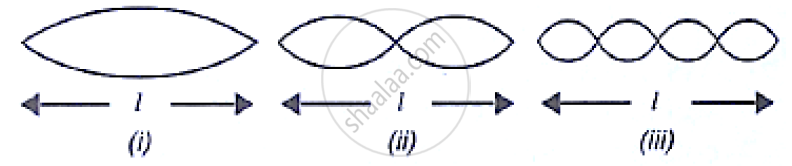
(a) which of the diagram shows the principal note?
(b) which has the frequency four times that of the first?
(c) what is the ratio of the frequency of the vibration in (i) and (ii)?
Explain how the principle of echo is used by the bat during its flight at night.
Why will an echo not be heard when the distance between the source of the sound and the reflecting surface is 10 m?
A cork piece is floating on the surface of the water in a pond. A piece of pebble is dropped into the water. What will be your observation?
In what respect does waveforms of noise and a musical note differ. Draw diagrams to illustrate your answer.
Match the following:
| 1. | Stethoscope | a. | Repeated reflections |
| 2. | Echogram | b. | Multiple reflections |
| 3. | SONAR | c. | Ultrasonic waves |
| 4. | Reverberation | d. | Speed of underwater objects |
