Advertisements
Advertisements
प्रश्न
Waves produced on the surface of the water are formed to move with a velocity of 24 ms−1. If the wavelength of these waves equals 20 cm. find the
(i) frequency (no. of waves produced per second)
(ii) the time period (i.e. the time required to produce one wave) for these waves.
Advertisements
उत्तर
(i) We have,
Wave velocity = Frequency × Wavelength
24 ms−1 = n × (20 × 10−2 m)
or n = `24/(24xx10^-2)` = 120 per second.
(ii) Time period = `1/"Frequency"=(1/120)"sec."` = 0.00833 sec.
The approximate frequency range of sound waves is about 15 to 200,000 Hz.
संबंधित प्रश्न
How is the frequency of a stretched string related to its length?
How is the frequency of a stretched string related it’s tension?
Define wave velocity term in relation to a wave.
A wave passes from one medium to another medium. Mention one property of the wave out of speed, frequency or wavelength which changes.
The following diagram shows three ways in which the string of an instrument can vibrate.
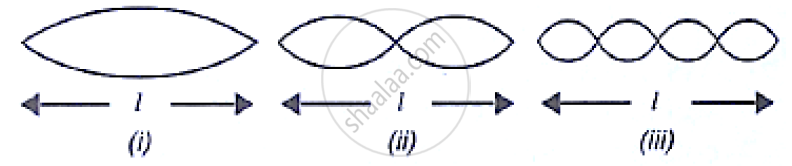
(a) which of the diagram shows the principal note?
(b) which has the frequency four times that of the first?
(c) what is the ratio of the frequency of the vibration in (i) and (ii)?
What are mechanical waves?
Draw a diagram representing a wave of amplitude 4 cm and wavelength 2 m. If the frequency of the wave is 150 Hz, calculate its velocity.
A sound wave whose frequency is 5000 Hz travels in air and then hits the water surface. The ratio of its wavelengths in water and air is ______.
Match the following:
| 1. | Stethoscope | a. | Repeated reflections |
| 2. | Echogram | b. | Multiple reflections |
| 3. | SONAR | c. | Ultrasonic waves |
| 4. | Reverberation | d. | Speed of underwater objects |
