Advertisements
Advertisements
प्रश्न
A cork piece is floating on the surface of the water in a pond. A piece of pebble is dropped into the water. What will be your observation?
Advertisements
उत्तर
As the piece of pebble is dropped into the water, waves are seen to be formed on the surface of the water which travels outwards from the point, where the pebble strikes the water surface. The cork piece simply tosses up and down without any appreciable forward or backward displacement. From this observation, it is concluded that water (medium) does not move, but the wave (or disturbance) advances.
संबंधित प्रश्न
How is the frequency of a stretched string related to its length?
The following diagram shows three ways in which the string of an instrument can vibrate.
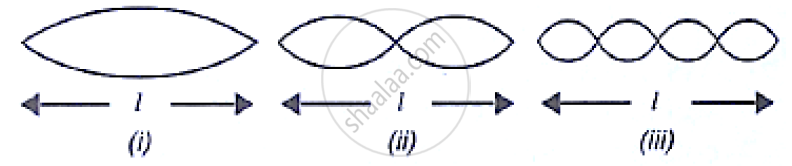
(a) which of the diagram shows the principal note?
(b) which has the frequency four times that of the first?
(c) what is the ratio of the frequency of the vibration in (i) and (ii)?
What is a megaphone ? Name the principle on which a megaphone works.
What is a stethoscope ? Name the principle on which a stethoscope works.
Define the term Frequency (as applied to sound waves)
Write the approximate value of the speed of sound in air.
What is meant by an echo? Explain.
Write short notes on reflection of sound waves from plane and curved surfaces.
