Advertisements
Advertisements
Question
A cork piece is floating on the surface of the water in a pond. A piece of pebble is dropped into the water. What will be your observation?
Advertisements
Solution
As the piece of pebble is dropped into the water, waves are seen to be formed on the surface of the water which travels outwards from the point, where the pebble strikes the water surface. The cork piece simply tosses up and down without any appreciable forward or backward displacement. From this observation, it is concluded that water (medium) does not move, but the wave (or disturbance) advances.
RELATED QUESTIONS
The displacement distance graph of two sound waves A and B, travelling in a medium, are as shown in the diagram below.
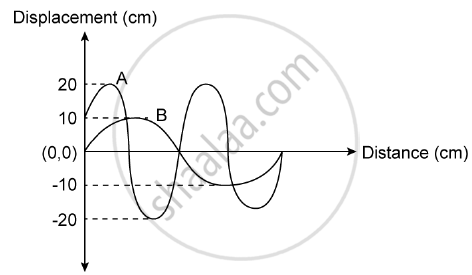
Study the two sound waves and compare their:
- Amplitudes
- Wavelengths
State two factors on which the speed of a wave travelling in a medium depends.
What is the condition necessary for an echo to be heard distinctly?
What is a megaphone ? Name the principle on which a megaphone works.
What is a soundboard ? Explain the working of a soundboard with the help of a labelled diagram.
What is meant by echo depth sounding?
State two factors on which the natural frequency of a body depends.
A sound wave whose frequency is 5000 Hz travels in air and then hits the water surface. The ratio of its wavelengths in water and air is ______.
Write short notes on reflection of sound waves from plane and curved surfaces.
