Advertisements
Advertisements
Question
Write short notes on reflection of sound waves from plane and curved surfaces.
Advertisements
Solution
When the sound waves hit the plane wall, they bounce off in a manner similar to that of light. When a loudspeaker is kept at an angle with respect to a wall (plane surface), then the waves coming from the source (assumed to be a point source) can be treated as spherical wave fronts. Hence, the reflected wave front on the plane surface is also spherical, such that its center of curvature can be treated as the image of the sound source (virtual or imaginary loud speaker) that can be assumed to be at a position behind the plane surface. These are shown in figures.

Reflection of sound through the plane surface
The behaviour of sound is different when it is reflected from different surfaces-convex or concave or plane. The sound reflected from a convex surface is spread out and so it is easily attenuated and weakened. Whereas, if it is reflected from the concave surface it will converge at a point and this can be easily amplified. The parabolic reflector (curved reflector) that is used to focus the sound precisely to a point is used in designing the parabolic mics which are known as high directional microphones.
We know that any surface (smooth or rough) can absorb sound. For instance, the sound produced in a big hall or auditorium or theatre is absorbed by the walls, ceilings, floor, seats etc. To avoid such losses, a curved sound board (concave board) is kept in front of the speaker, in such a way that the board reflects the sound waves of the speaker towards the audience. This method will minimize the spreading of sound waves in all possible direction in that hall it also enhances the uniform distribution of sound throughout the hall. Hence a person sitting at any position in that hall can hear the sound without any disturbance.


Reflection of sound through the curved surface
APPEARS IN
RELATED QUESTIONS
A certain sound has a frequency of 256 hertz and a wavelength of 1.3 m.
1) Calculate the speed with which this sound travels
2) What difference would be felt by a listener between the above sound and another sound traveling at the same speed, but of wavelength 2.6 m?
The displacement distance graph of two sound waves A and B, travelling in a medium, are as shown in the diagram below.
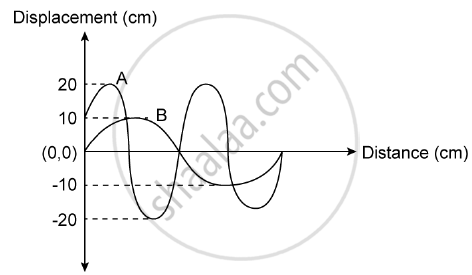
Study the two sound waves and compare their:
- Amplitudes
- Wavelengths
Define wavelength term in relation to a wave.
A wave passes from one medium to another medium. Mention one property of the wave out of speed, frequency or wavelength which does not change.
How do bats avoid obstacles in their way, when in flight?
Name the waves which are used in sonar to find the depth of a sea. Give one reason for their use.
What is the shape of a soundboard kept behind the speaker on the stage of a big hall ?
What is a megaphone ? Name the principle on which a megaphone works.
What do you mean by reflection of sound? State one condition for the reflection of a sound wave. Name a device in which reflection of sound wave is used.
(i) A man stands at a distance of 68 m from a cliff and fires a gun. After what time interval will he hear the echo, if the speed of sound in air is 340 ms−1?
(ii) If the man had been standing at a distance of 12 m from the cliff would he have heard a clear echo?
