Advertisements
Advertisements
Question
Explain reflection at the boundary of a rarer medium.
Advertisements
Solution
- Consider a wave travelling in a solid medium striking on the interface between the solid and the air. The compression exerts a force F on the surface of the rarer medium.
- As a rarer medium has smaller resistance for any deformation, the surface of separation is pushed backward.
- As the particles of the rarer medium are free to move, a rarefaction is produced at the interface. Thus, compression is reflected as rarefaction and a rarefaction travels from right to left.
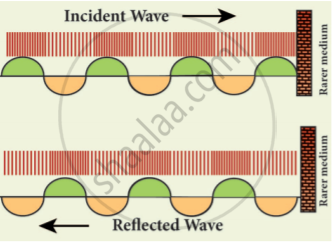
Reflection of sound at a rarer medium
APPEARS IN
RELATED QUESTIONS
The human ear can detect continuous sounds in the frequency range from 20 Hz to 20,000 Hz. Assuming that the speed of sound in air is 330 m s−1 for all frequencies, calculate the wavelengths corresponding to the given extreme frequencies of the audible range.
A wire of length 80 cm has a frequency of 256 Hz. Calculate the length of a similar wire under similar tension, which will have frequency 1024 Hz
Define amplitude term in relation to a wave.
Define frequency term in relation to a wave.
Define wave velocity term in relation to a wave.
State two differences between the light and sound waves.
What adjustments would you make for tuning a stringed instrument for it to emit a note of a desired frequency?
What is the shape of a soundboard kept behind the speaker on the stage of a big hall ?
How are bats able to fly in the dark?
State two factors on which the natural frequency of a body depends.
A cork piece is floating on the surface of the water in a pond. A piece of pebble is dropped into the water. What will be your observation?
In what respect does waveforms of noise and a musical note differ. Draw diagrams to illustrate your answer.
Waves produced on the surface of the water are formed to move with a velocity of 24 ms−1. If the wavelength of these waves equals 20 cm. find the
(i) frequency (no. of waves produced per second)
(ii) the time period (i.e. the time required to produce one wave) for these waves.
(i) A man stands at a distance of 68 m from a cliff and fires a gun. After what time interval will he hear the echo, if the speed of sound in air is 340 ms−1?
(ii) If the man had been standing at a distance of 12 m from the cliff would he have heard a clear echo?
A sound wavelength of 0.332 m has a time period of 10−3 s. If the time period is decreased to 10−4 s, calculate the wavelength and frequency of the new wave.
Explain Reflection at curved surfaces.
