Advertisements
Advertisements
Question
Why is an echo not heard when the distance between the source of sound and reflection body is less than 10 m?
Advertisements
Solution
The impression of sound lasts on the eardrum for `1/10` of a second. In `1/10` of a second, the sound travels a distance `332"m"/"s"xx1/10"s"` = 33.2. Thus, the minimum distance between the source of the sound and the reflecting body should be `33.2/2` = 16.6 m.
As the distance 10 m is far less than 16.6 m, therefore the ear cannot make out when the original sound had died and echo has been received. Thus, no echo is heard.
RELATED QUESTIONS
How is the frequency of a stretched string related it’s tension?
The displacement distance graph of two sound waves A and B, travelling in a medium, are as shown in the diagram below.
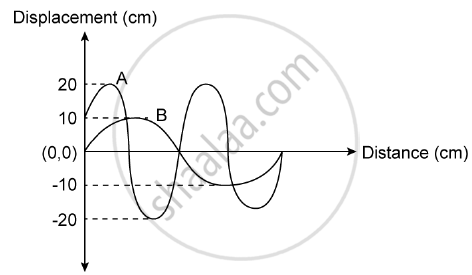
Study the two sound waves and compare their:
- Amplitudes
- Wavelengths
Define amplitude term in relation to a wave.
State the use of echo by a bat, dolphin and fisherman.
The following diagram shows three ways in which the string of an instrument can vibrate.
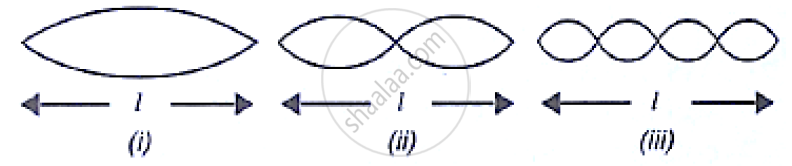
(a) which of the diagram shows the principal note?
(b) which has the frequency four times that of the first?
(c) what is the ratio of the frequency of the vibration in (i) and (ii)?
What is the shape of a soundboard kept behind the speaker on the stage of a big hall ?
A sound wavelength of 0.332 m has a time period of 10−3 s. If the time period is decreased to 10−4 s, calculate the wavelength and frequency of the new wave.
What is mean by the reflection of sound?
