Advertisements
Advertisements
प्रश्न
Explain reflection at the boundary of a rarer medium.
Advertisements
उत्तर
- Consider a wave travelling in a solid medium striking on the interface between the solid and the air. The compression exerts a force F on the surface of the rarer medium.
- As a rarer medium has smaller resistance for any deformation, the surface of separation is pushed backward.
- As the particles of the rarer medium are free to move, a rarefaction is produced at the interface. Thus, compression is reflected as rarefaction and a rarefaction travels from right to left.
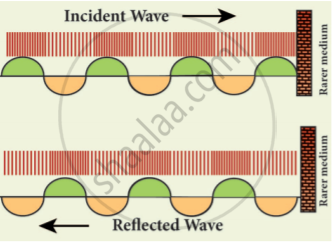
Reflection of sound at a rarer medium
APPEARS IN
संबंधित प्रश्न
Define amplitude term in relation to a wave.
How do bats avoid obstacles in their way, when in flight?
What adjustments would you make for tuning a stringed instrument for it to emit a note of a desired frequency?
The following diagram shows three ways in which the string of an instrument can vibrate.
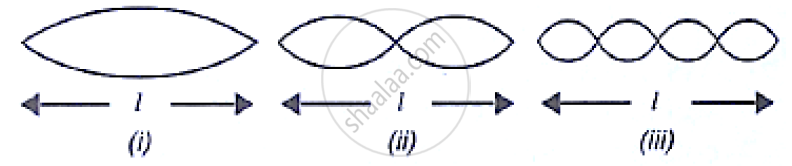
(a) which of the diagram shows the principal note?
(b) which has the frequency four times that of the first?
(c) what is the ratio of the frequency of the vibration in (i) and (ii)?
What is the shape of a soundboard kept behind the speaker on the stage of a big hall ?
What is a megaphone ? Name the principle on which a megaphone works.
What is a soundboard ? Explain the working of a soundboard with the help of a labelled diagram.
Draw a labelled diagram to show the multiple reflections of sound in a part of the stethoscope tube.
What are mechanical waves?
Point out the waves from the given list, i.e., light, sound, radio waves, ultrasonic waves, and thermal radiation, the energy is propagated by mechanical waves.
Write the approximate value of the speed of sound in iron.
Mention two properties of a wave, one property which varies and the other which remains constant when the wave passes from one medium to another.
What do you understand by the ‘Echolocation system of Dolphins’?
A radio signal, sent towards the surface of the moon, is received in 2.5 seconds. If the speed of the radio waves is 3 × 10⁸ ms−1, find the distance of the moon from the earth.
A sound wave whose frequency is 5000 Hz travels in air and then hits the water surface. The ratio of its wavelengths in water and air is ______.
