Advertisements
Advertisements
प्रश्न
Distinguish between compression and rarefaction.
Advertisements
उत्तर
A longitudinal wave propagates by means of compressions and rarefactions.
When a vibrating object moves forward, it pushes and compresses the air in front of it creating a region of high pressure. This region is called a compression (C), as shown in Fig. This compression starts to move away from the vibrating object. When the vibrating object moves backwards, it creates a region of low pressure called rarefaction (R), as shown in Fig.

A vibrating object creating a series of compressions (C)
and rarefactions (R) in the medium
Compressions are the regions of high density where the particles of the medium come very close to each other and rarefactions are the regions of low density where the particles of the medium move away from each other.
APPEARS IN
संबंधित प्रश्न
Guess which sound has a higher pitch: guitar or car horn?
Write true or false for a given statement.
Sound can only be produced by vibrating bodies.
What are wavelength, frequency, time period and amplitude of a sound wave?
What type of wave is represented :
(a) by density-distance graph?
(b) by displacement-distance graph?
Give two examples each of longitudinal waves and transverse waves.
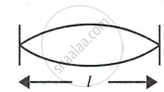
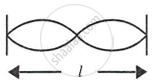
Fig. shows three ways in which a string of length l in an instrument can vibrate.
 |
 |
 |
| (i) | (ii) | (iii) |
- Which of the diagram shows the principle note?
- Which vibration has the frequency four times that of the first?
- Which vibration is of the longest wavelength?
- What is the ratio of the frequency of the vibration in (i) and (ii)?
The distance between one crest and one trough of a sea wave is 4.5 m. If the waves are produced at the rate of 240/min, calculate the wave velocity.
On placing your ear close to an iron railing which is tapped some distance away, sound is heard twice. Explain, why?
