Advertisements
Advertisements
Question
Distinguish between compression and rarefaction.
Advertisements
Solution
A longitudinal wave propagates by means of compressions and rarefactions.
When a vibrating object moves forward, it pushes and compresses the air in front of it creating a region of high pressure. This region is called a compression (C), as shown in Fig. This compression starts to move away from the vibrating object. When the vibrating object moves backwards, it creates a region of low pressure called rarefaction (R), as shown in Fig.

A vibrating object creating a series of compressions (C)
and rarefactions (R) in the medium
Compressions are the regions of high density where the particles of the medium come very close to each other and rarefactions are the regions of low density where the particles of the medium move away from each other.
APPEARS IN
RELATED QUESTIONS
Calculate the wavelength of a sound wave whose frequency is 220 Hz and speed is 440 m/s in a given medium.
Write true or false for a given statement.
Waveforms of two different stringed instruments can be the same.
Which of the following frequency of sound can be generated by a vibrating simple pendulum as well as by the vibrating vocal cords of a rhinoceros ?
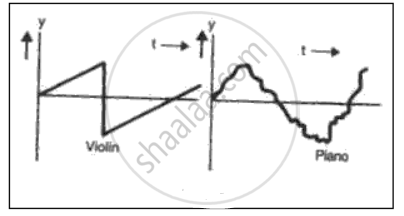
In fig. 2 two musical notes of the same pitch and same loudness are played on a violin and on a piano. Their wave forms are as shown in the diagram below. Explain why the wave patterns are different.
The speed of sound is more in hydrogen than in nitrogen. Is this statement true? Give a reason for your answer.
Match the following.
| Ultrasonics | Frequency below 20Hz |
| Speed of sound in air | Needs material medium |
| Infrasonics | 330ms-1 |
| Sound propagation | Frequency more than 20000 Hz |
An earthquake produces which kind of sound before the mainshock wave begins
What do you understand by the term echo?
In longitudinal waves, the particle vibrates in a ______ direction of propagation.
Distinguish between compression and rarefactions.
