Advertisements
Online Mock Tests
Chapters
1: Forces: Turning Forces and Uniform Circular Motion
2: Work, Power and Energy
3: Machines
(B) Light
4: Refraction of Light
5: Electromagnetic Waves and Spectrum
(C) Sound
6: Sound
(D) Electricity and Magnetism
7: Electric Circuits, Resistance and Ohm's Law
8: Electric Energy, Power and Household Circuits
9: 1. Electromagnetism 2. Magnetic Effects of Electric Current 3. Electromagnetic Induction
(E) Heat
▶ 10: Calorimetry
(F) Modern Physics
11: Radioactivity
Advertisements
Solutions for Chapter 10: Calorimetry
Below listed, you can find solutions for Chapter 10 of CISCE Goyal Brothers Prakashan for अ न्यू अप्रोच टू आईसीएसई [अंग्रेजी] कक्षा १०.
Goyal Brothers Prakashan solutions for अ न्यू अप्रोच टू आईसीएसई [अंग्रेजी] कक्षा १० 10 Calorimetry EXERCISE-1 [Pages 233 - 237]
Define heat energy as it is understood by the common man.
Define heat energy on the basis of kinetic theory of matter.
What is the old and basic unit of heat energy? Define it.
Name and define the bigger unit of heat energy in calories.
How many calories are in one kilocalorie?
Name the SI unit of heat.
How many calories are in one S.I unit of heat energy?
How many joules are in one calorie of heat energy?
How many joules are in one kilocalorie of heat energy?
Name three factors which determine the amount of heat energy absorbed or given out by a body.
Name two factors which determine thermal capacity of a substance.
Define specific heat capacity.
State the specific heat capacity units in (i) calories (ii) joules in
- C.G.S. system
- S.I. System
- Name a substance having the highest specific heat capacity.
- State its magnitude in (i) the C.G.S. system and the S.I. system.
- State its magnitude in (i) calories in the C.G.S. system and the S.I. system.
What do you understand by the statement that the specific heat capacity of copper is 400 J kg−1 K−1?
What do you understand by the statement that the thermal capacity of an iron vessel is 460 J K−1?
State the underlying principle on which the method of mixtures is based for the determination of the specific heat capacity of substances.
Explain, why is water used as a coolent in motor car radiators?
200 J of heat energy is supplied by a burner to 100 g of metal when its temperature rises by 8°C. What is the specific heat capacity of the metal?
Explain, why is water sprayed on roads in evening in hot summer?
How much heat energy is given out by 270 g of a substance at 80°C if its temperature drops to 20°C?
[Specific heat capacity of the substance is 520 J kg−1 K−1]
Explain, Why is it advisabile to pour cold water over burns, caused on human body, by hot solids?
A burner is supplying heat at a rate of 50 J s−1. A solid with a specific heat capacity of 720 J kg−1 K−1 is heated from 20°C to 100°C in one minute. Find the mass of the solid.
Explain, why do sandy soils, get heated up quickly as compared to wet soils?
An electric kettle is rated 1500 W. Calculate the time in which it will bring 1.5 kg of water at 25°C to its boiling point.
[Take specific heat capacity of water = 4200 J kg−1 K−1]
Explain, why temperature in hot summer, falls sharply after a sharp shower?
Calculate the final temperature when 2 kg of cold water at 5°C is mixed with 0.4 kg of hot water at 95°C.
[Specific heat capacity of water = 4.2 J g−1°C−1]
Explain, why does a wise farmer water his fields, if forecast is forst?
A metal drill with a power of 500 W drills a hole in a lead cube of mass 0.25 kg in 6.5 s. If all the energy of the drill is transferred to the metal cube, calculate the rise in temperature.
[Specific heat capacity of lead is 130 J kg−1K−1]
Give two reasons as to why copper is preferred over other metals for making calorimeters.
What is meant by specific heat capacity?
Some hot water was added to three times its mass of cold water at 10°C and the resulting temperature was found to be 20°C. What was the temperature of the hot water?
40 g of water at 60°C is poured into a vessel containing 50 g of water at 20°C. The final temperature recorded is 30°C. Calculate the thermal capacity of vessel.
[Take the specific heat capacity of water is 4.2 J g−1°C−1]
An equal quantity of heat is supplied to two substances A and B. The substance A shows a greater rise in temperature. What can you say about the heat capacity of A as compared to that of B?
What energy change would you Expect to take place in the molecules of a substance when it undergoes:
(i) a change in its temperature?
(ii) a change in itsstate without any change in its temperature?
Answer the following question.
Clearly, state the difference between heat and temperature?
Define calorimetry ?
What do you mean by degradation of energy?
Give one example where high specific heat capacity of water is used as heat reservoir ?
Give one example where high specific heat capacity of water is used as cooling purposes?
200 g of hot water at 80°C is added to 300 g of cold water at 10°C. Calculate the final temperature of the mixture of water. Consider the heat taken by the container to be negligible. [Specific heat capacity of water is 4200 J kg−1 °C−1]
Differentiate between heat capacity and specific heat capacity.
Write an expression for the heat energy liberated by a hot body.
Some heat is provided to a body to raise its temperature to 50°C. What will be the corresponding rise on Kelvin scale?
Specific heat capacity of substance A is 3.8 J g-1 K-1whereas the specific heat capacity of substance B is 0.4 J g-1 K-1. Which of the two is a good conductor of heat? How is one led to this conclusion?
MULTIPLE CHOICE QUESTIONS Choose the most appropriate option.
The specific heat capacity of a substance ______.
changes with the mass of given substance.
changes with the area or volume of substance.
changes with rise or fall in temperature.
is a constant quantity for a given substance.
Land and sea breezes are formed in coastal regions because:
water has very high specific heat capacity than the land.
land has very high specific heat capacity than the water
sea water cools the cooler regions.
all the above.
The base of cooking pans is made thicker and heavy because:
it lowers the heat capacity of the pan
it increases the heat capacity of the pan
the food does not get charred and keeps hot for a long time
- it increases the heat capacity of the pan and the food does not get charred and keeps hot for a long time.
The SI unit of specific heat capacity is:
J kg−1
JK]−1
J kg−1 K−1
kJ kg−1 K−1
The specific heat capacity of water in SI system is:
4.2 J kg−1 K−1
42 J kg−1 K−1
4200 J kg−1 K−1
420 J kg−1 K−1
SI unit of thermal capacity is:
J kg−1
kJ kg−1
J K−1
cal °С−1
Heat energy is:
Sum total of K.E. of the molecules of matter only
Sum total of P.E. of the molecules of matter only
Sum total of kinetic and potential energies of all the molecules
None of these.
Temperature is:
Sum total of K.E. of the molecules of matter
Sum total of P.E. of the molecules of matter
Average of K.E. of all the molecules of matter
Average of P.E. of all the molecules of matter
S.I. unit of heat energy is:
calorie
kilocalorie
joule
mega joule
S.I. unit of temperature is:
°C
°F
K
°R
The heat energy is a:
additive quantity
subtractive quantity
non-additive quantity
both additive quantity and subtractive quantity
The flow of heat energy from one body to another body is determined.
The amount of heat contained in the bodies
The temperature difference between the bodies
The mass of the bodies
None of these
One kilocalorie is equal to:
4.186 J
4816 J
4618 J
4186 J
The amount of heat energy required by 1 g of pure water, so as to raise its temperature through 1°C is known as:
calorie
kilocalorie
joule
kilojoule
Heat capacity of a body is the ______.
energy needed to melt a body without change in its temperature
energy needed to raise the temperature of a body by 1°C
increase in volume of the body when its temperature increases by 1°C
total amount of internal energy that is constant
If H J is the heat absorbed by a substance such that θ°C is the rise in its temperature then the thermal capacity of the substance is:
H θ J °C
\[\frac{H}{\theta} \frac{\mathrm{~J}}{{ }^{\circ} \mathrm{C}}\]
\[\frac{\theta}{H} \frac{{ }^{\circ} \mathrm{C}}{\mathrm{J}}\]
none of these
The thermal capacity of a solid is \[\frac{400 \mathrm{~J}}{\mathrm{~K}}\]. The amount of heat supplied to it will be ______ if its temperature rises by 40 K.
16000 J
1600 J
1000 J
none of these
The factor (s) on which the heat absorbed by a body depends:
mass of body
specific heat capacity of body
rise in temperature of body
all of these
Which of the following is a constant quantity for a given substance?
weight of a substance
heat capacity of a substance
specific heat capacity of a substance
none of these
If H is the heat absorbed by a substance, 'm' is the mass; C specific heat capacity and θ, the rise in temperature, then specific heat capacity is given by the expression.
\[\mathrm{C}=\frac{H}{m \theta}\]
\[\mathrm{C}=\frac{H \theta}{m}\]
\[\mathrm{C}=\frac{H m}{\theta}\]
\[\mathrm{C}=\frac{m \theta}{H}\]
Which is not a good prerequisite for a calorimeter?
Calorimeter should be made of copper
Calorimeter should be highly polished from inner and outer side
Calorimeter should have large mass
Calorimeter should be always used with stirrer
Which is a precaution for the determination of specific heat capacity?
Calorimeter should be clean and highly polished
Calorimeter should be well insulated
The substance whose specific heat is determined should be transferred to calorimeter as quickly as possible
All of these
Water is used in hot water bottles because:
Water has highest specific heat capacity
Water at comparatively low temperature (50°C) can store lot of heat energy
Water slowly radiates heat and keeps the temperature cozy.
All of these
In cold countries, water is used for internal heating because:
Water has highest sp. heat capacity
Water can carry large amount of heat at comparatively moderate temperature
Water is the cheapest carrier of heat
All of these
The base of an electric press is made thick and heavy because:
The heavy base can store large amount of heat.
The heavy base will not allow the temperature to go beyond safe limits
In case of electric supply stops the press will keep hot for some time.
All of these
Direction for Q. Numbers 26 to 30: The questions given below are Assertion (A) and Reason (R) type questions. Choose the correct answer from options given below:
Assertion (A): Heat capacity is the amount of heat energy required to raise the temperature of a given mass of the body by 1°C.
Reason (R): Specific heat capacity is the amount of heat energy required to raise the temperature of unit mass of the body by 1°C.
Both Assertion (A) and Reason (R) are true and Reason (R) is the correct explanation of Assertion (A).
Both Assertion (A) and Reason (R) are true but Reason (R) is not the correct explanation of Assertion (A).
Assertion (A) is false, but Reason (R) is true.
Assertion (A) is true, but Reason (R) is false.
Assertion (A): Specific heat capacity of a substance X is 3.8 Jg−1 K−1 and of the substance Y is 0.4 Jg−1 K−1.
Reason (R): For the same heat energy and same mass, the rise in temperature of X will be more than Y, thus, X is a good conductor of heat.
Both Assertion (A) and Reason (R) are true and Reason (R) is the correct explanation of Assertion (A).
Both Assertion (A) and Reason (R) are true but Reason (R) is not the correct explanation of Assertion (A).
Assertion (A) is false, but Reason (R) is true.
Assertion (A) is true, but Reason (R) is false.
Assertion (A): The base of a cooking pan is made thick.
Reason (R): Its heat capacity becomes large due to which it gets heated slowly and imparts sufficient heat energy at a slow rate to the food for its proper cooking.
Both Assertion (A) and Reason (R) are true and Reason (R) is the correct explanation of Assertion (A).
Both Assertion (A) and Reason (R) are true but Reason (R) is not the correct explanation of Assertion (A).
Assertion (A) is false, but Reason (R) is true.
Assertion (A) is true, but Reason (R) is false.
Assertion (A): A wise farmer waters his field in the evening when forecast is frosty night.
Reason (R): Water has highest specific heat capacity. It releases large amount of heat energy on cooling and saves crop from frost damage.
Both Assertion (A) and Reason (R) are true and Reason (R) is the correct explanation of Assertion (A).
Both Assertion (A) and Reason (R) are true but Reason (R) is not the correct explanation of Assertion (A).
Assertion (A) is false, but Reason (R) is true.
Assertion (A) is true, but Reason (R) is false.
Assertion (A): Calorimeter is always made from copper vessel.
Reason (R): The heat capacity of a calorimeter is very large.
Both Assertion (A) and Reason (R) are true and Reason (R) is the correct explanation of Assertion (A).
Both Assertion (A) and Reason (R) are true but Reason (R) is not the correct explanation of Assertion (A).
Assertion (A) is false, but Reason (R) is true.
Assertion (A) is true, but Reason (R) is false.
Complete the following sentences by choosing correct answers from brackets.
The quantity of heat energy required to raise the temperature of one gram of pure water through 1°C is called one ______.
joule
calorie
Unit of specific heat capacity is ______.
kg2m2s−2K−1
m2s−2K−1
The amount of heat energy required to raise the temperature of a unit mass of a substance through 1°C is known as ______.
heat capacity
thermal capacity
specific heat capacity
During summer, water is sprinkled on roads, because water has ______ specific heat capacity and can absorb large amount of heat.
lowest
highest
In coastal regions, during day time the breeze which blows is commonly called ______ breeze.
land
sea
Match the statements in Column A with those in Column B.
| Column A | Column B |
|---|---|
| (a) Sea breeze | (i) A coastal breeze which blows during night. |
| (b) Temperature | (ii) A liquid having highest specific heat capacity. |
| (c) Heat energy | (iii) The average kinetic energy of all the molecules of a substance |
| (d) Land breeze | (iv) The sum total of potential and kinetic energy of all the molecules of a substance. |
| (e) Water | (v) A coastal breeze which blows during day. |
Goyal Brothers Prakashan solutions for अ न्यू अप्रोच टू आईसीएसई [अंग्रेजी] कक्षा १० 10 Calorimetry NUMERICAL PROBLEMS ON SPECIFIC HEAT CAPACITY [Pages 237 - 242]
How much heat energy is gained when 0.6 kg of water at 25°C is brought to its boiling point?
[Sp. heat capacity of water = 4200 J kg−1°C−1].
Practice Problems 1:
A solid of mass 0.15 kg is heated from 10°C to 90°C. If the specific heat capacity of the solid is 390 J kg−1°C−1, find the heat absorbed by the solid.
A liquid of mass 0.2 kg and temperature 135°C is cooled to 25°C. If the specific heat capacity of the liquid is 750 J kg−1°C−1, find the heat energy given out. [Hint: θF = (135 – 25) = 110°C]
800 calories of heat is required to raise the temperature of 0.080 kg of a liquid from 10°C to 100°C. Find its specific heat capacity (a) in calories (b) in joules.
Practice Problems 2:
0.08 kg of a substance is heated from 30°C to 130°C when 2000 calories of energy are supplied to it. Calculate the specific heat capacity of the substance in (a) calories (b) joules.
A solid of mass 60 g at 100°C is placed in 150 g of water at 20°C. The final steady temperature is 25°C. Calculate the heat capacity of the solid.
[Specific heat capacity of water = 4.2 J g−1 K−1]
0.120 kg of copper of specific heat capacity 100 calkg−1°C−1 and at 20°C is heated by a burner for two minutes, which supplies heat energy at a rate of 20 calories/sec. Calculate the final temperature of the copper.
Practice Problems 3:
272 calories of heat energy is required to heat 0.02 kg of a metal of specific heat capacity 170 cal kg−1°C−1 to a temperature T. If the initial temperature of the metal is 20°C, calculate the final temperature T.
3.75 × 10⁵ calories of heat is given out by 5 kg of water at 100°C. Calculate the temperature of the cooled water. The specific heat capacity of water is 1000 calkg−1°C−1.
In an experiment to measure the temperature of the flame of a Bunsen burner, a lump of copper of mass 0.12 kg is heated on the flame for a long time. The copper then is quickly transferred into a beaker of negligible heat capacity containing 0.84 kg of water and the temperature of the water rose from 15°C to 35°C. Calculate the temperature of the flame.
[Given, specific heat capacity of copper = 0.4 J g−1 °C−1, specific heat capacity of water = 4.2 J g−1 °C−1]
A liquid of mass 100 g loses heat at a rate of 200 Js−1 for 1 minute. If the temperature of the liquid drops by 100°C, calculate the specific heat capacity of the liquid.
An electric immersion heater is switched on for 8 minutes. The heat supplied by it raises the temperature of 500 g of water from 10°C to 60°C. Calculate the power of the heater in watts.
[Specific heat of water = 4.2 Jg−1°C−1]
Practice Problems 4:
A heater, rated 1000 W, is used to heat 1.5 kg of water at 40°C to its boiling point. Calculate the time in which the water starts to boil. Specific heat capacity of water is 4200 Jkg−1°C−1.
400 g of mercury of specific heat capacity 0.14 Jg−1°C−1 is heated by a 200 W heater for 1 min. and 40 s. If initially mercury is at 0°C, calculate its final temperature.
A power drill of 400 W makes a hole in a lead cube of specific heat capacity 0.13 Jg−1°C−1 in 80 s. If the temperature of the lead rises from 27°C to 327°C, calculate the mass of the lead cube.
A solid of mass 25 g (sp. heat capacity 0.8 J/g°C) and at 120°C is placed in 100 g of water at 20°C. Calculate the final temperature of the mixture. Specific heat capacity of water is 4.2 Jg−1°C−1.
Practice Problems 5:
A solid of mass 150 g at 200°C is placed in 0.4 kg of water at 20°C till a constant temperature is attained. the S.H.C. of the solid is 0.5 Jg−1 K−1, find the resulting temperature of the mixture.
A liquid of mass 100 g at 120°C is poured in water at 20°C, when the final temperature recorded is 40°C. If the specific heat capacity of the liquid is 0.8 Jg−1°C−1, calculate the initial mass of water.
A solid of mass 50 g at 150°C is placed in 100 g of water at 11°C when the final temperature recorded is 20°C. Find the specific heat capacity of the solid. (specific heat capacity of water = 4.2 J/g °C)
40 g of hot water is poured in 100 g of cold water, when the temperature of cold water rises by 10°C. If the temperature of hot water is 60°C, calculate the initial temperature of cold water.
Practice Problems 6:
20 g of hot water at 80°C is poured into 60 g of cold water, when the temperature of cold water rises by 20°C. Calculate the initial temperature of cold water. [Zero degree celsius]
50 g of a hot solid of specific heat capacity 0.25 Jg−1°C−1 and at 100°C is placed in 80 g of cold water, when the temperature of cold water rises by 3°C. Find the initial temperature of the cold water.
The heat capacity of a solid of mass 175 g is 315 J °C−1. Calculate the specific heat capacity of the solid.
Practice Problems 7:
What mass of a solid of specific heat capacity 0.75 Jg−1°C−1 will have heat capacity 93.75 J°C−1?
A solid of mass 1.2 kg has sp. heat capacity of 1.4 Jg−1°C−1. Calculate its heat capacity in SI units.
A solid of mass 80 g and at 75°C is dropped into 150 g of water at 15°C, which is contained in a copper calorimeter of mass 50 g. The final temperature attained by the mixture is 25°C. If the specific heat capacity of copper and water is 400 Jkg−1K−1 and 4200 Jkg−1K−1 respectively, calculate the sp. heat capacity of the solid in SI system.
Practice Problems 8:
A solid of mass 0.15 kg and at 100°C is placed in 0.25 kg of water, contained in a copper calorimeter of mass 0.12 kg, at 10°C. If the final temperature of the mixture is 20°C, calculate the sp. heat capacity of the solid.
[Given S.H.C. of water = 4200 Jkg−1 K−1; S.H.C. of copper = 400 Jkg−1 K−1]
A piece of brass of mass 200 g and at 100°C, is placed in 400 g of turpentine oil, contained in a copper calorimeter of mass 50 g at 15°C. The final temperature recorded is 23°C. Find the sp. heat capacity of turpentine oil.
[S.H.C. for brass = 370 Jkg−1K−1; S.H.C. of copper = 390 Jkg−1K−1]
80 g of water at 60°C is poured into a vessel containing 100 g of water at 20°C. The final temperature recorded is 30°C. Calculate the thermal capacity of the vessel.
Practice Problems 9:
A copper vessel contains 200 g of water at 24°C. When 112 g of water at 42°C is added, the resultant temperature of the water is 30°C. Calculate the thermal capacity of the calorimeter.
A copper calorimeter contains 50 g of water at 16°C. When 40 g of water at 36°C is added, the resulting temperature of the mixture is 24°C. Calculate the heat capacity of the calorimeter.
A liquid P of specific heat capacity 1800 Jkg−1K−1 and at 80°C is mixed with a liquid R of specific heat capacity 1200 Jkg−1K−1 and at 30°C. After mixing, the final temperature of the mixture is 50°C. In what proportion by weight are the liquids mixed?
Practice Problems 10:
A liquid X of specific heat capacity 1050 Jkg−1K−1 and at 90°C is mixed with a liquid Y of specific heat capacity 2362.5 Jkg−1K−1 and at 20°C, when the final temperature recorded is 50°C. Find in what proportion the weights of the liquids are mixed.
You are required to make a water bath of 50 kg at 45°C, by mixing hot water at 90°C, with cold water at 20°C. Calculate the amount of hot water required.
[Hint: Let the amount of hot water = x
∴ Amount of cold water = (50 − x) kg]
Heat energy is given to 150 g of water, such that its temperature rises by 20 K. When the same amount of heat energy is given to a liquid X of mass 100 g its temperature rises by 80 K. Calculate (a) heat energy given to water (b) the specific heat capacity of liquid X.
[Take sp. heat capacity of water = 4.2 J g−1 K−1]
Practice Problems 11:
Heat energy is given to 100 g of water, such that its temperature rises by 10 K. When the same heat energy is given to a liquid L of mass 50 g its temperature rises by 50 K. Calculate (a) heat energy given to water (b) the specific heat capacity of liquid L.
[Take sp. heat capacity of water = 4200 JKg−1K−1]
Heat energy is given to 80 g of alcohol (sp. heat capacity 2200 Jkg−1K−1) when its temperature rises by 20 K. If the same heat energy is given to 200 g of mercury of specific heat capacity 140 Jkg−1K−1, what is the rise in temperature?
Water falls from a height of 800 m from a water fall. If the initial temperature of water at top of water fall is 10°C, what is its temperature at the bottom? Assume all the energy of the falling water changes to heat energy.
[Take g = 10 ms−2 and sp. heat capacity of water 4200 J kg−1K−1]
Practice Problems 12:
A copper ball is dropped from a vertical height of 1200 m. If the initial temperature of copper ball at the height is 12°C, what is its temperature on reaching the ground? Assume all its kinetic energy changes to heat energy and sp. heat capacity of copper is 400 Jkg−1°C−1 and g = 10 ms−2.
A waterfall is 1.5 km high. If the temperature of water at its top is 20°C find its temperature at the bottom of waterfall, assuming all the kinetic energy is converted into heat energy.
[Take g = 10 ms−2 and sp. heat capacity of water 4200 Jkg−1°C−1].
Goyal Brothers Prakashan solutions for अ न्यू अप्रोच टू आईसीएसई [अंग्रेजी] कक्षा १० 10 Calorimetry EXERCISE-2 [Pages 246 - 249]
Define the following:
Melting or fusion:
Define the following terms: Melting point
What do you mean by solidification or deposition?
Define solidification point.
How does the numerical value of the melting point compare with the solidification point?
- When a substance starts melting, its temperature does not rise till whole the substance melts. Explain.
- What happens to the heat energy supplied during melting?
- What is the common name of this energy in (ii)?
Define the following term:
Latent heat
Define the following term:
Latent heat of fusion of ice
Define the term specific latent heat of fusion of ice. State its S.I. unit.
(i) State the unit of latent heat of fusion in:
- C.G.S system
- S.I system
(ii) Name the substance which has the highest specific latent heat of fusion.
(iii) State the value of the above heat in:
- C.G.S system
- S.I system
State two precautions observed during the experimental determination of specific latent heat of fusion of ice.
The specific latent heat of fusion of ice is 336000 J kg−1. What do you understand from the statement?
An electric heater of 500 W is used to melt 200 g of dry ice at 0°C. Find the time required to melt ice. Assume all the heat energy supplied by the heater is absorbed by the ice, and the specific latent heat of fusion of ice is 336000 J kg−1.
Why does weather get moderate in cold countries when the freezing of lakes and other bodies start?
A copper ball of specific heat capacity 0.9 Jg−1°C−1 and mass 500 g is placed on a block of ice, when 800 g of ice just melts. Find the temperature of the copper ball. [Assume specific latent heat of fusion of ice = 340 Jg−1]
Why should bits of ice be wiped before adding them to the calorimeter during the determination of the specific latent heat of fusion of ice?
200 g of ice at 0°C, just melts when a cube of metal of mass 175 g and at 800°C is placed over a block of ice. Calculate the specific latent heat of fusion of ice.
[Specific heat capacity of metal is 0.6 J g−1°C−1]
Why does the heat supplied to a substance during its change of state not cause any rise in its temperature?
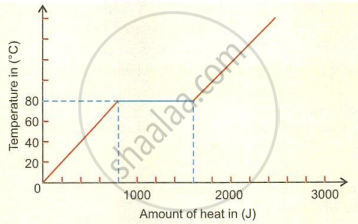
A substance in the form of a solid at 0°C. The amount of heat added to this substance and the temperature of the substance are plotted on the given graph. If the specific heat capacity of the solid is 0.5 J g−1°C−1, find from the graph
- Mass of the substance.
- The specific latent heat of fusion of the substance in the liquid state.
In what way does the temperature of water at the bottom of a waterfall differ from the temperature at the top? Explain the reason.
A certain quantity of ice at 0°C is heated till it changes into steam at 100°C. Draw a time-temperature heating curve to represent it. Label the two phase changes in your graph.
Why does it become very cold when ice starts melting in cold countries?
A metallic ball of mass 200 g and at 200°C is placed over a block of ice, when 100 g of ice melts. If the specific latent heat of fusion of ice is 336 J g−1, find the specific heat capacity of the metallic ball.
Why is melting ice a better coolant than water at 0°C?
Calculate the amount of ice at 0°C, which should be added to 250 g of water at 45°C, such that resulting temperature of the mixture is 5°C.
[Specific latent heat of fusion of ice = 336 J g−1]
Why does the weather become warm during snowfall?
25 g of ice at −25°C is heated by a burner till it forms boiling water at 100°C. If the specific heat capacity of ice is 2 J g−1°C−1 and the specific latent heat of fusion of ice is 336 J g−1, calculate:
- Amount of heat energy supplied by the burner to bring the ice to 0°C.
- Amount of heat energy supplied by burner to melt ice.
- Amount of heat energy supplied by burner to bring water to boil.
Explain why does the weather become very cold after a hail storm.
A block of lead of mass 250 g, at 27°C was heated in a furnace till it completely melted. Find the quantity of heat required
(a) To bring the lead block upto its melting point,
(b) To completely melt the block at its melting point (Melting point of lead is 327°C, Sp. heat cap. of lead is 0.13 J/gk and latent heat of fusion of lead is 26 J/g)
Why are icebergs carried thousands of kilometers away without melting substantially?
A refrigerator converts 100 g of water at 20°C to ice at −10°C in 73.5 minutes. If the specific heat capacity of ice and water are 2 J g−1°C−1 and 4.2 J g−1°C−1 and specific latent heat of fusion of ice is 336 J g−1 calculate:
- heat extracted to bring the water to 0°С.
- heat extracted to change the water to ice at 0°C.
- Heat extracted to lower the temperature of ice to −10°C.
- Average rate of extraction of heat.
Why does snow/ice not melt on the mountains during summer?
A molten metal weighing 150 g is kept at its melting point 800 °C, when the metal is allowed to solidify at the same temperature, it releases 75,000 J of heat energy. What is the specific latent heat of the metal?
Why do pieces of ice add to a drink, rather than water at 0°C, so as to cool it?
How much heat energy is released when 5 g of water at 20° C changes to ice at 0° C?
[Specific heat capacity of water = 4.2 J g−1 ° C−1 Specific latent heat of fusion of ice = 336 J g−1]
MULTIPLE CHOICE QUESTIONS Choose the most appropriate option.
The amount of heat energy required to melt a given mass of a substance at its melting point without any rise in its temperature is called as the ______.
specific heat capacity
specific latent heat of fusion
latent heat of fusion
specific latent heat of freezing
The S.I. unit of specific latent heat is ______.
cal g-1
cal g-1 K-1
J kg-1
J kg-1 K-1
Jg-1
The specific latent heat of fusion of ice in SI system is:
80 calg−1
336 × 103 Jkg−1
2260 × 103 Jkg−1
336 Jkg−1
The amount of heat energy required to melt 1 kg of a substance at its melting point, without any rise in temperature is known as:
specific latent heat of fusion
latent heat of fusion
heat capacity
specific heat capacity
In cold countries, the weather becomes moderate and pleasant, when the lakes, rivers and other water bodies start freezing because:
ice has the highest specific latent heat capacity of fusion
every gram of water at 0°C on freezing releases 336 J of heat energy in the atmosphere.
Ice has the highest specific latent heat capacity of fusion, and every gram of water at 0°C on freezing releases 336 J of heat energy into the atmosphere.
none of these
It becomes bitterly cold when ice on the hills starts melting because:
ice has the highest heat capacity of fusion of 336 Jg−1
every gram of ice which melts takes 336 J of heat energy from atmosphere.
Ice has the highest heat capacity of fusion of 336 Jg−1, and every gram of ice that melts takes 336 J of heat energy from the atmosphere.
none of these
A solid of mass 0.15 kg is heated from 10°C to 90°C. If the specific heat capacity of the solid is 390 J kg−1°C−1, the heat absorbed by the solid is:
4680 J
4860 J
4608 J
6480 J
A liquid of mass 0.2 kg and at a temperature 135°C is cooled to 25°C. If specific heat capacity of liquid is 750 J kg−1°C−1, the heat energy given out by liquid is:
15600 J
16500 J
16600 J
5160 J
A solid of specific heat capacity 0.75 Jg−1°C−1, has heat capacity of 93.75 J°C−1. The mass of this solid is:
126 g
120 g
124 g
125 g
A solid of mass 1.2 kg has a specific heat capacity of 1.4 Jg−1°C. The heat capacity of the solid in SI system is:
1680 JK−1
1675 JK−1
1685 JK−1
1670 JK−1
3.75 × 10⁵ calories of heat is given out by 5.0 kg of water at 100°C. If the specific heat capacity of water is 1000 cal kg−1°C−1 the temperature of the cold water is:
25°C
25.5°C
24.5°C
24°C
A solid X of mass 80 g and at 80°C melts completely to form a liquid at 80°C, by absorbing 720 J of heat energy. The sp. latent heat of fusion of the solid is:
9.5 Jg−1
8.0 Jg−1
8.5 Jg−1
9.0 Jg−1
Direction for Q. Numbers 13 to 17: The questions given below are Assertion (A) and Reason (R) type questions. Choose the correct answer from options given below:
Assertion (A): For a pure substance, melting point and freezing point are identical.
Reason (R): For a given mass of substance, the amount of heat energy absorbed during melting is different as that liberated during freezing.
Both Assertion (A) and Reason (R) are true and Reason (R) is the correct explanation of Assertion (A).
Both Assertion (A) and Reason (R) are true but Reason (R) is not the correct explanation of Assertion (A).
Assertion (A) is false, but Reason (R) is true.
Assertion (A) is true, but Reason (R) is false.
Assertion (A): A substance on heating undergoes (i) a rise in its temperature (ii) a change in its phase without change in its temperature.
Reason (R): In first case, average kinetic energy of molecules increases while in the second case, average potential energy of molecules increases.
Both Assertion (A) and Reason (R) are true and Reason (R) is the correct explanation of Assertion (A).
Both Assertion (A) and Reason (R) are true but Reason (R) is not the correct explanation of Assertion (A).
Assertion (A) is false, but Reason (R) is true.
Assertion (A) is true, but Reason (R) is false.
Assertion (A): It becomes very cold after the hail storm.
Reason (R): Ice has a high specific heat capacity of 2.1 Jg−1°C−1.
Both Assertion (A) and Reason (R) are true and Reason (R) is the correct explanation of Assertion (A).
Both Assertion (A) and Reason (R) are true but Reason (R) is not the correct explanation of Assertion (A).
Assertion (A) is false, but Reason (R) is true.
Assertion (A) is true, but Reason (R) is false.
Assertion (A): When ice melts to form water at 0°C, the latent heat of fusion is contained in the liquid water.
Reason (R): Ice has highest specific latent heat of fusion whose magnitude is 336 kJ kg−1.
Both Assertion (A) and Reason (R) are true and Reason (R) is the correct explanation of Assertion (A).
Both Assertion (A) and Reason (R) are true but Reason (R) is not the correct explanation of Assertion (A).
Assertion (A) is false, but Reason (R) is true.
Assertion (A) is true, but Reason (R) is false.
Assertion (A): When water at 0°C freezes to form ice the temperature stays at 0°C, till all the water freezes.
Reason (R): During change of state from water to ice no amount of heat is absorbed or given out.
Both Assertion (A) and Reason (R) are true and Reason (R) is the correct explanation of Assertion (A).
Both Assertion (A) and Reason (R) are true but Reason (R) is not the correct explanation of Assertion (A).
Assertion (A) is false, but Reason (R) is true.
Assertion (A) is true, but Reason (R) is false.
Complete the following sentences by choosing correct answers from brackets.
Ice at 0°C is supplied with heat energy. This energy increases the ______ energy of the molecules of ice, till whole of it melts.
kinetic
potential
mechanical
The C.G.S unit of specific latent heat of a solid is ______.
kJ g−1
Jg−1
Jg−1°C−1
Ice cubes are used for cooling a drink, because every gram of ice at 0°C on melting absorbs ______ of energy more than water at 0°C.
3360 J
336 J
340 J
The amount of energy required to melt one kilogram of a substance at its melting point without any rise in temperature is called ______.
Latent heat of fusion of substance
specific latent heat capacity of substance
The constant temperature at which a solid starts changing into liquid state is called ______ point of solid.
fusion
ebullition
solidification
Match the statements in Column A with those in Column B.
| Column A | Column B |
|---|---|
| (a) 336000 Jkg−1 | (i) The energy of the molecules of a substance which changes during the change of state. |
| (b) Kinetic energy | (ii) The temperature at which a liquid starts changing into solid state. |
| (c) Solidification point | (iii) Mathematical expression for heat absorbed or given out during change of state. |
| (d) Potential energy | (iv) Magnitude of specific latent heat of fusion of ice in S.I. system. |
| (e) Mass × specific latent heat of fusion | (v) The energy of the molecules of a substance which changes during rise or fall in temperature of substances. |
Goyal Brothers Prakashan solutions for अ न्यू अप्रोच टू आईसीएसई [अंग्रेजी] कक्षा १० 10 Calorimetry NUMERICAL PROBLEMS ON SPECIFIC LATENT HEAT OF FUSION [Pages 249 - 254]
How much heat energy is required to melt 4 kg of ice at 0°C? (The sp. latent heat of fusion of ice is 336 × 103 J kg−1)
Practice Problems 1:
4000 calories of heat energy is supplied to crushed ice at 0°C, such that it completely melts to form water at 0°C. If sp. latent heat of fusion of ice is 80 cal g−1, what is the mass of ice?
A solid of mass 80 g and at 80°C melts completely to form liquid at 80°C by absorbing 640 J of heat energy. What is the sp. latent heat of fusion of solid?
50 g of ice at –20°C is heated on an electric heater till it forms water at 100°C. Calculate:
- Heat energy required to raise the temperature of ice to 0°C.
- Heat energy required to melt ice so as to form water at 0°С.
- Heat energy required to bring water to the temperature of 100°C.
[Take specific latent heat of fusion of ice = 340 Jg−1, specific heat capacity of water = 4.2 Jg−1°C−1 and specific heat capacity of ice = 2.1 Jg−1°C−1].
Practice Problems 2:
100 g of ice at −10°C is heated on a gas stove till it forms water at 80°C. Calculate:
- Heat energy required to bring the ice to 0°C.
- Heat energy required to melt the ice.
- Heat energy required to bring water to 80°C.
[sp. heat capacity of ice = 2 Jg−1°C−1; sp. heat capacity of water = 4.2 Jg−1°C−1 and sp. latent heat of fusion of ice is 336 Jg−1]
400 g of wax at 10°C is heated to 80°C, when it starts melting. On complete melting wax is further heated so that temperature rises to 130°C. Calculate:
- Heat energy required to bring the wax to its melting point.
- Heat energy required to melt the wax.
- Heat energy required to bring the molten wax to 130°C.
[sp. heat capacity of solid wax = 1.5 Jg−1°C−1; sp. heat capacity of liquid wax = 1.8 J−1°C−1; sp. latent heat of wax = 80 Jg−1]
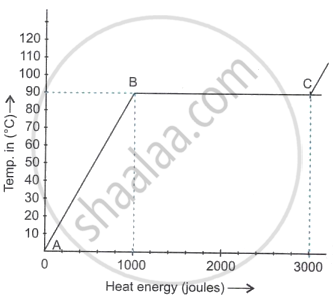
A solid initially at 0°C is heated. The graph shows the variation in temperature with the amount of heat energy supplied. If the specific heat capacity of the solid is 0.6 Jg−1°C−1, from the graph calculate the (a) mass of solid (b) sp. latent heat of fusion of solid.
Practice Problems 3:
The diagram below shows a cooling curve for a substance X:
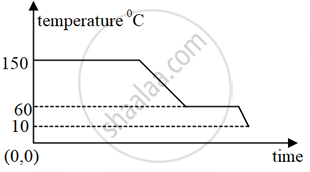
(a) State the temperatures at which the substance condenses.
(b) Mention the temperature range in which the substance is in its liquid state.
(c) State true or false:
The amount of heat released when a substance is cooled by 10°C in its liquid state is greater than the heat released when it is cooled by the same amount in its solid state.
The diagram below shows a cooling curve for a substance X:
(a) State the temperatures at which the substance condenses.
(b) Mention the temperature range in which the substance is in its liquid state.
(c) State true or false:
The amount of heat released when a substance is cooled by 10°C in its liquid state is greater than the heat released when it is cooled by the same amount in its solid state.
Water at 100°C is poured in a bucket containing 4 kg of crushed ice at 0°C, such that all the ice melts and the final temperature recorded is 0°C. Calculate the amount of hot water added to the ice.
[Take the specific heat capacity of water = 4200 Jkg−1K−1 and sp. latent heat of ice = 336000 Jkg−1].
Practice Problems 4:
Water at 80°C is poured into a bucket containing 1.5 kg of crushed ice at 0°C, such that all the ice melts and the final temperature recorded is 0°C. Calculate the amount of hot water added to the ice.
[Take the specific heat capacity of water as 4200 Jkg−1 K−1 and sp. latent heat of ice = 336 × 103 Jkg−1]
1.6 kg of boiling water at 100°C is poured into 2 kg of crushed ice at 0°C, such that final temperature recorded is 0°C. Calculate the specific latent heat of ice. [sp. heat capacity of water = 4200 Jkg−1 K−1]
10 g of ice at −25°C is heated by a burner which is supplying heat energy at a rate of 250 J/s. Calculate the time, in which the water formed from ice attains a temperature of 90°C. Specific heat capacity of ice is 2.1 Jg−1°C−1 and specific latent heat of ice is 336 Jg−1.
Practice Problems 5:
40 g of ice at −10°C is heated by a heater of power 250 W, such that water formed from it, attains the temperature equal to the boiling point of water. For how long is the heater switched on?
[S.H.C. of ice = 2 Jg−1°C−1; Sp. latent heat of ice = 340 Jg−1]
An immersion heater is placed in crushed ice at –40°C, contained in a Perspex jar, such that water at 50°C is formed. If the power of the heater is 200 W and it is switched on for 3 min and 20 s, calculate the initial mass of ice. S.H.C. of ice = 2.1 Jg−1°C−1 and latent heat of ice = 336 Jg−1.
A burner supplies heat energy at a rate of 434 Js−1 for 60 seconds when 40 g of ice at 0°C changes to water at 75°C. Calculate the latent heat of ice.
Calculate the amount of ice, which is sufficient to cool 150 g of water, contained in a vessel of mass 50 g (S.H.C. = 0.4 Jg−1°C−1) at 30°C, such that the final temperature of the mixture is 5°C.
[Specific latent heat of ice is 336 Jg−1]
Practice Problems 6:
A vessel of mass 80 g (S.H.C. = 0.8 Jg−1°C−1) contains 250 g of water at 35°C. Calculate the amount of ice at 0°C, which must be added to it, so that the final temperature is 5°C. [Sp. latent heat of ice = 340 Jg−1]
A vessel of mass 100 g (S.H.C. = 0.2 calg−1°C−1) contains 500 g of water at 37°C. Calculate the amount of ice, which should be added to the vessel, so that the final temperature is 17°C.
[S.H.C. of water = 1 calg−1°C−1 and S.L.H. of ice = 80 cal g−1]
10 g of ice at 0°C is added to 10 g of water at 80°C, such that the temperature of the mixture is 0°C. Calculate the sp. latent heat of ice. [S.H.C. of water = 4.2 Jg−1°C−1]
A metal ball of mass 400 g and at 600°C is placed on a block of ice, when 428 g of ice melts. If the sp. heat capacity of the metal ball is 0.6 Jg−1°C−1, calculate sp. latent heat of ice.
Practice Problems 7:
A metal ball of mass 0.5 kg and at 900°C is placed on a block of ice, till it attains the temperature of ice. If the S.H.C. of the metal ball is 850 Jkg−1K−1, calculate the amount of ice, which melts. Take S.L.H. of ice = 34 × 104 Jkg−1.
Calculate the temperature of a furnace, when a 400 g of a copper ball, taken out from it, melts only 400 g of ice to form water at 0°C. Take S.H.C. of copper = 0.4 Jg−1°C−1 and S.L.H. of ice = 336 Jg−1.
A metal ball of 0.20 kg and at 200°C, when placed on an ice block melts 100 g of ice, when its temperature stops falling. If sp. latent heat of ice is 340 Jg−1, calculate specific heat capacity of the metal ball.
500 g of molten lead at its m.p. is just kept in molten state by a heater of 25 W. If the heater is switched off, the temperature of lead starts falling after 7 min. Calculate the sp. latent heat of fusion of lead.
Practice Problems 8:
A 30 watt immersion heater just keeps 600 g of molten metal at its melting point. The heater is switched off and the temperature starts falling after 6 min. Calculate sp. latent heat of fusion of the metal.
A hydrocarbon of mass 1.5 kg is just kept in the molten state by a heater of 500 W. If the heater is switched off, the temperature starts dropping after 4 min. Calculate sp. latent heat of fusion of the hydrocarbon.
A vessel of negligible thermal capacity contains 4 kg of water at 40°C. Into the vessel is added 3 kg of ice at 0°C. Calculate the (a) heat energy given out by water to attain temperature of 0°C (b) mass of ice which melts (c) mass of water at 0°C.
[Take sp. heat capacity of water = 4200 Jkg−1°C−1 and sp. latent heat of fusion of ice = 340 × 103 Jkg−1]
Practice Problems 9:
500 g of water at 60°C is contained in a vessel of negligible heat capacity. Into this water is added 400 g of ice at 0°C. Calculate the amount of ice which does not melt.
[Take SHC of water = 4.2 J g−1°C−1 and S.L.H. of ice = 336 J g−1]
2 kg of water at 100°C is contained in a vessel of negligible heat capacity. Into this water is added 3 kg of ice at 0°C. Calculate the amount of water at 0°C at the end of the experiment.
[Take SHC of water = 4.2 × 10³ J kg−1°C−1 and SLH of ice = 336 × 103 J kg−1]
What would be result when 600 g of iron clips (SHC = 0.48 Jg−1°C−1) at 600°C are placed in 800 g of ice at 0°C? [SLH of ice = 336 Jg−1]
Practice Problems 10:
A vessel with a negligible heat capacity contains 1000 g of ice at 0°C. Into it is poured 100 g of water at 100°С. What would be the result at the end of the experiment?
[SHC of water = 4.2 Jg−1°C−1 and SLH of ice = 336 Jg−1]
What will be the result when 400 g of copper clips at 500°C are placed in 800 g of crushed ice at 0°C?
[SHC of copper = 0.42 J g−1°C−1 and SLH of ice = 340 J g−1]
Goyal Brothers Prakashan solutions for अ न्यू अप्रोच टू आईसीएसई [अंग्रेजी] कक्षा १० 10 Calorimetry COMPETENCY-FOCUSED PRACTICE QUESTIONS RELEASED BY CISCE [Pages 254 - 255]
Data: mass = 10 g, quantity of heat supplied = 120 J, rise in temperature = 10°C
STATEMENT A: The heat capacity of the substance is 12 J/g.
STATEMENT B: The specific heat capacity of the substance is 1.2 J/gK.
Only statement A is correct.
Only statement B is correct.
Both statements A and B are correct.
Both statements A and B are incorrect.
Three metals, A, B and C, are supplied with the same quantity of heat. Their masses are in the ratio 2 : 3 : 4. If they show the same rise in temperature, then the ratio of their thermal capacities will be:
1 : 1 : 1
4 : 3 : 2
2 : 3 : 4
2 : 3 : 1
Two substances, A and B, have the same mass. Substance A has a higher specific heat capacity than substance B. What consequences would you expect when these substances are subjected to the same amount of heat energy?
Substance A will experience a smaller temperature change than substance B.
Substance A will experience a larger temperature change than substance B.
Both substances will experience the same temperature change.
Either of them can show a greater change in temperature as the temperature change depends on factors other than specific heat capacity.
Rivers which originate from the glaciers at high altitudes have a supply of water throughout the year. This is because ice in high mountains does not melt all at once. This is due to:
high specific heat of ice.
low specific heat of ice.
low specific latent heat of fusion of ice.
high specific latent heat of fusion of ice.
During the change of state of a substance from solid to liquid, heat is absorbed by a body, but its temperature does not rise. Which of the following statements explains the phenomenon?
Only K.E of the molecules increases, but P.E remains the same.
Only P.E of the molecules increases, but K.E remains the same.
Both K.E and P.E of the molecules increase.
There is no increase in the P.E and K.E of the molecules.
Two metals A and B have specific heat capacities in the ratio 2 : 3. If they are supplied the same amount of heat then
Which metal piece will show a greater rise in temperature given their masses is the same?
Two metals A and B have specific heat capacities in the ratio 2:3. If they are supplied same amount of heat then
If the mass ratio of metal A and metal B is 3:5 then calculate the ratio in which their temperatures rise.
Convert to SI unit: 1J/g °F
Why does 1 g of water at 0°C have 336 J more heat energy than 1g of ice at 0°C?
On a hot summer day, we often put ice cubes to cool the water. Why?
The difference between the temperature of water at the bottom and the top of a waterfall is 0.2 °C. Calculate the height of the waterfall.
[g = 10 N kg−1, Specific heat capacity of water = 4200 J kg−1 °C−1]
In the physics laboratory, various blocks of materials labelled A and B, each with masses ranging from 10 grams to 50 grams, are utilised to determine their respective heat capacities. Subsequently, a graph is plotted to depict the relationship between the heat capacity and the mass of the materials, as shown.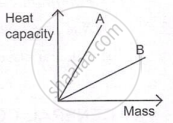
- Plot a graph illustrating the relationship between the mass and specific heat capacity of materials A and B.
- Which material is a relatively better conductor?
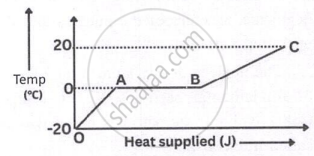
In the graph, a given quantity of ice is converted to water.
- What does the portion AB represent?
- Why is the portion AB parallel to the time axis?
- Why is the slope OA steeper than the slope BC?
Solutions for 10: Calorimetry
Goyal Brothers Prakashan solutions for अ न्यू अप्रोच टू आईसीएसई [अंग्रेजी] कक्षा १० chapter 10 - Calorimetry
Shaalaa.com has the CISCE Mathematics अ न्यू अप्रोच टू आईसीएसई [अंग्रेजी] कक्षा १० CISCE solutions in a manner that help students grasp basic concepts better and faster. The detailed, step-by-step solutions will help you understand the concepts better and clarify any confusion. Goyal Brothers Prakashan solutions for Mathematics अ न्यू अप्रोच टू आईसीएसई [अंग्रेजी] कक्षा १० CISCE 10 (Calorimetry) include all questions with answers and detailed explanations. This will clear students' doubts about questions and improve their application skills while preparing for board exams.
Further, we at Shaalaa.com provide such solutions so students can prepare for written exams. Goyal Brothers Prakashan textbook solutions can be a core help for self-study and provide excellent self-help guidance for students.
Concepts covered in अ न्यू अप्रोच टू आईसीएसई [अंग्रेजी] कक्षा १० chapter 10 Calorimetry are Heat, The Temperature and a Thermometer, Factors Affecting the Quantity of Heat Absorbed to Increase the Temperature of a Body, Heat vs Temperature, Specific Heat Capacity, Heat Capacity vs Specific Heat Capacity, Specific Heat Capacity of Some Common Substances, Calorimetry, Principle of Method of Mixtures or Principle of Calorimetry, Natural Phenomena and Consequences of High Specific Heat Capacity of Water, Examples of High and Low Heat Capacity, Change of State, Melting and Freezing, Melting Point and Its Effects, Vaporisation or Boiling, Boiling Point and Its Effects, Latent Heat, Explanation of Latent Heat of Melting based on Kinetic Model, Natural Consequences of High Specific Latent Heat of Fusion of Ice, Specific Latent Heat of Fusion of Ice, Thermal or Heat Capacity.
Using Goyal Brothers Prakashan अ न्यू अप्रोच टू आईसीएसई [अंग्रेजी] कक्षा १० solutions Calorimetry exercise by students is an easy way to prepare for the exams, as they involve solutions arranged chapter-wise and also page-wise. The questions involved in Goyal Brothers Prakashan Solutions are essential questions that can be asked in the final exam. Maximum CISCE अ न्यू अप्रोच टू आईसीएसई [अंग्रेजी] कक्षा १० students prefer Goyal Brothers Prakashan Textbook Solutions to score more in exams.
Get the free view of Chapter 10, Calorimetry अ न्यू अप्रोच टू आईसीएसई [अंग्रेजी] कक्षा १० additional questions for Mathematics अ न्यू अप्रोच टू आईसीएसई [अंग्रेजी] कक्षा १० CISCE, and you can use Shaalaa.com to keep it handy for your exam preparation.
