Advertisements
Advertisements
प्रश्न
A solid of mass 50 g at 150°C is placed in 100 g of water at 11°C when the final temperature recorded is 20°C. Find the specific heat capacity of the solid. (specific heat capacity of water = 4.2 J/g °C)
Advertisements
उत्तर
Mass of the solid, ms = 50 g
Initial temperature of the solid, ts = 150°C
Mass of water, mw = 100 g
Temperature of water, tw = 11°C
Final temperature of the mixture, t = 20°C
According to the principle of calorimetry
Heat gained by water = Heat lost by the solid
`:.m_wc_w(t - t_w) = m_sc_s(t_s - t)`
∴ 100 × 4.2 × (20 - 11) = 50 × cs × (150 - 20)
3780 = 6500 cs
`c_s = 3780/6500`
`∴ c_s = 0.58` J/g °C
APPEARS IN
संबंधित प्रश्न
A geyser heats water flowing at the rate of 3.0 litres per minute from 27 °C to 77 °C. If the geyser operates on a gas burner, what is the rate of consumption of the fuel if its heat of combustion is 4.0 × 10⁴ J/g?
You have a choice of three metals A, B, and C, of specific heat capacities 900 Jkg-1 °C-1, 380 Jkg-1 °C-1 and 460 Jkg-1 °C-1 respectively, to make a calorimeter. Which material will you select? Justify your answer.
Name the radiations for which the green house gases are opaque ?
(b) 2000 J of heat energy is required to raise the temperature of 4 kg of a
metal by 3°c. Which expression gives the specific heat capacity of the metal?
Explain, why water is considered as best liquid for quenching thirst?
A substance is in the form of a solid at 0°C. The amount of heat added to this substance and the temperature of the substance are plotted on the following graph:
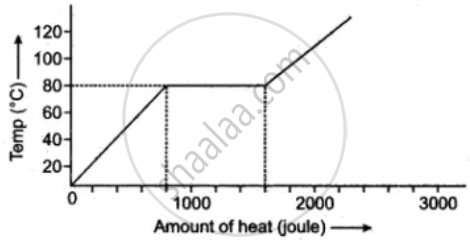
If the specific heat capacity of the solid substance is 500 J/kg °G, find from the graph, the mass of the substance.
Which of the following substances (A, B and C) has the highest specific beat?
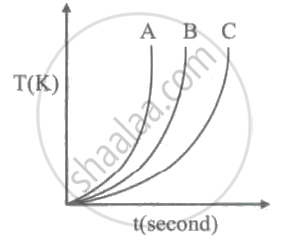
The specific heat capacity of ______ is maximum.
The molar specific heats of an ideal gas at constant pressure and volume are denoted by Cp and Cv, respectively. If `gamma = "C"_"p"/"C"_"v"` and R is the universal gas constant, then Cv is equal to ______.
Specific heat capacity of a substance X is 1900 Jkg-1°C-1 means ______.
