Advertisements
Advertisements
प्रश्न
A, B, C and D are four points on a hemispherical cup placed inverted on the ground. Diameter BC = 360 cm and AE = `R/3` (R is the radius of the cup). A small spherical mass of 500 g at rest at the point A slides down along the smooth surface of the cup. Assuming there is no loss of energy, calculate its:
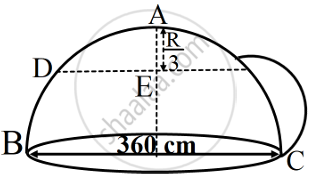
- Potential Energy at A relative to B.
- Speed at point B (lowest point).
- Kinetic Energy at D (g = 10 ms−2).
Advertisements
उत्तर
Given: Diameter = 360 cm = 3.6 m
Radius (R) = 1.8 m
Mass of the sphere (m) = 500 g = 0.5 kg
AE = `R/3 = 1.8/3` = 0.6 m
Acceleration due to gravity (g) = 10 ms−2
Condition: No energy loss so energy is conserved.
a. As, point B is on the ground, then
Height of point A relative to point B = radius of hemisphere (R) = 1.8 m
Potential energy UA at A relative to B is given by,
UA = m × g × R
Substituting the values we get,
UA = 0.5 × 10 × 1.8
⇒ UA = 9 J
Hence, the potential energy at point A relative to point B is 9 J.
b. As there are no energy losses, total mechanical energy is the same at all points of the path due to conservation of mechanical energy and all the potential energy at point A will be converted to kinetic energy at point B.
Let the speed at point B be ‘vB’.
Then,
Kinetic energy at B = UA
⇒ `1/2 (mv_B)^2`
⇒ `1/2 xx 0.5 xx (v_B)^2`
⇒ `(v_B)^2 = (2 xx 9)/0.5`
⇒ `(v_B)^2` = 36
⇒ vB = `sqrt36`
⇒ vB = 6 ms−1
So, the speed at point B is 6 ms−1.
c. As points D and E are on the same height, at these points their potential and kinetic energies are equal, i.e.,
Potential energy at point D = Potential energy at point E
Kinetic energy at point D = Kinetic energy at point E
Now,
Distance of point D from the ground = R − AE = 1.8 − 0.6 = 1.2 m
Thus, potential energy at point D = mg × 1.2 = 0.5 × 10 × 1.2 = 6 J
Mechanical energy at point D = Potential energy at point D + Kinetic energy at point D
As, mechanical energy is conserved,
Mechanical energy at point D = Potential energy at point A
⇒ Potential energy at point D + Kinetic energy at point D = 9
⇒ 6 + Kinetic energy at point D = 9
⇒ Kinetic energy at point D = 9 − 6 = 3 J
So, kinetic energy at point D is 3 J.
