Advertisements
Advertisements
प्रश्न
An electric bulb is rated 240V-60W and is working at 100% efficiency.
(i) Calculate the resistance of bulb.
(ii) (a) Draw the circuit diagram.
(b) What is the rate of conversion of energy in each bulb?
(c) Total power used by the bulbs.
Advertisements
उत्तर
(i) From P = `"V"^2/"R"`
Resistance of bulb (R) = `"V"^2/"P" = (240 xx 240)/60 = 960 Omega`
(ii) (a)
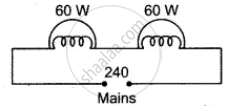
(b) Resistance of bulbs in series = (960 + 960) Ω = 1920 Ω
∴ Current in series circuit I = `"V"/"R" = 240/1920 = 0.125` A
∴ Rate of conversion of energy in any one bulb in 1 second = I2Rt
= (0.125)2 × 960 × 1 = 15.5
(c) Power of 1 bulb in series circuit = 15 W
So poewr of 2 bulb in series circuit = 2 × 15 W = 30 W.
APPEARS IN
संबंधित प्रश्न
If a bulb of 60W is connected across a source of 220V, find the current drawn by it.
An electric heater is rated at 2 kW. Electrical energy costs Rs 4 per kWh. What is the cost of using the heater for 3 hours?
(a) Rs 12
(b) Rs 24
(c) Rs 36
(d) Rs 48
A current of 0.2 A flows through a wire whose ends are at a potential difference of 15 V.
calculate:
(i) the resistance of the wire and
(ii) the heat energy produced in 1 minute.
Define 1 kilowatt hour.
How does earthing prevent electrical shock?
How can electric energy consumed by an electric appliance be calculated in kilowatt hour (kWh)?
An electric bulb is rated as 100W – 250V. What information does it convey? Calculate the current through the filament of the bulb.
What is the commercial unit of electrical energy?
Two heaters A and B have power rating of 1 kW and 2 kW, respectively. Those two are first connected in series and then in parallel to a fixed power source. The ratio of power outputs for these two cases is ______
