Advertisements
Advertisements
प्रश्न
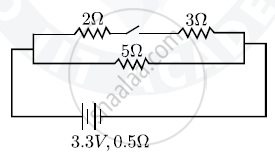
The diagram above shows a circuit with the key k open. Calculate :
(i) the resistance of the circuit when the key k is open.
(ii) the current drawn from the cell when the key k is open.
(iii) the resistance of the circuit when the key k is closed.
(iv) the current drawn from the cell when the key k is closed.
Advertisements
उत्तर
(i) when k is open
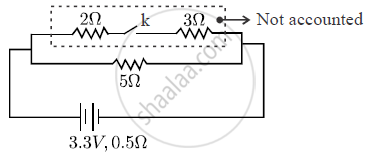
Req = 5Ω + 0.5 Ω = 5.5Ω
(ii) `i = v/(R_(eq))|_("case k open")`
`=(3.3v)/(5.5 Ω ) = 3/5 =0.6 A`
(iii) when k is closed,
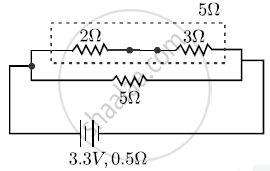
`R_(eq) =(R_1R_2)/(R_1 + R_2) = (5xx5)/(5+5) = 2.5 Ω`
`R_(Total) = 2.5 Ω + 0.5 Ω = 3.0 Ω`
(iv) `i =v/(R_T) = 3.3/3.0 = 1.1A`
APPEARS IN
संबंधित प्रश्न
An electric bulb is rated 220 V and 100 W. When it is operated on 110 V, the power consumed will be ______.
Name two safety devices which are connected to the live wire of a household electric circuit
State the S.I. units of electrical power and electrical energy.
(i) Define the household unit of electricity.
(ii) What is the voltage of the electricity that is generally supplied to a house?
Name a metal that is used as an electron emitter. Give one reason for using this metal.
Out of the three fuses with current ratings 5A, 10A, 15A, which one is to be connected in a geyser circuit marked 3 kW, 220V? Give reason for your answer.
The equation I2R seems to suggest that the rate of heating in a resistor is reduced if resistance decreases, whereas equation P = V2/R suggests just the opposite. How do you reconcile this problem?
A consumer uses 4 lamps of 60 watt, 2 lamps of 40 watt, and 2 lamps of 100 watt. All these are used for 6 hour daily. Find the total bill for 30 days when the rate of energy is 75 paise per unit and the meter rent is Rs. 1.
A 100-watt electric bulb is used for 5 hours daily and four 60 watt bulbs are used for 5 hours daily. Calculate the energy consumed (in kWh) in the month of January.
A cooler of 1500 W, 200 volts and a fan of 500 W, 200 volts are to be used from a household supply. The rating of fuse to be used is:
