Advertisements
Advertisements
Question
An electric bulb is rated 240V-60W and is working at 100% efficiency.
(i) Calculate the resistance of bulb.
(ii) (a) Draw the circuit diagram.
(b) What is the rate of conversion of energy in each bulb?
(c) Total power used by the bulbs.
Advertisements
Solution
(i) From P = `"V"^2/"R"`
Resistance of bulb (R) = `"V"^2/"P" = (240 xx 240)/60 = 960 Omega`
(ii) (a)
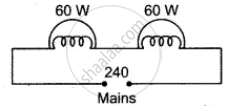
(b) Resistance of bulbs in series = (960 + 960) Ω = 1920 Ω
∴ Current in series circuit I = `"V"/"R" = 240/1920 = 0.125` A
∴ Rate of conversion of energy in any one bulb in 1 second = I2Rt
= (0.125)2 × 960 × 1 = 15.5
(c) Power of 1 bulb in series circuit = 15 W
So poewr of 2 bulb in series circuit = 2 × 15 W = 30 W.
APPEARS IN
RELATED QUESTIONS
What is the SI unit of electric energy?
An electric bulb is connected to a 220 V power supply line. If the bulb draws a current of 0.5 A, calculate the power of the bulb.
A bulb of 40 W is used for 12.5 h each day for 30 days. Calculate the electrical energy consumed.
A resistor of resistance R is connected to an ideal battery. If the value of R is decreased, the power dissipated in the resistor will ______________ .
An electric bulb marked 220 V, 100 W will get fused if it is made to consume 150 W or more. What voltage fluctuation will the bulb withstand?
Name three main characteristics of an heating element.
What changes in energy occur in an electric heater?
Give two precautious that you would take while putting off an electric switch.
An electric heater is rated 220 V, 550 W. Calculate the electrical energy consumed in 3 hours?
