Advertisements
Advertisements
Question
Two electric lamps each rating 100 W, 110 V are connected in series to a 220 V power supply and two other electric lamps each of marking 100 W, 220 V are connected in parallel to the same power supply. Will anyone of the two combinations give more light than the other? Give a reason for your answer.
Advertisements
Solution
Both combinations will give the same light.
Reason: Each combination has the same power namely 200 W.
RELATED QUESTIONS
Name the commercial unit of electric energy.
Name the quantity whose unit is kilowatt?
When a current of 4.0 A passes through a certain resistor for 10 minutes, 2.88 × 10⁴ J of heat are produced. Calculate
the power of the resistor.
the voltage across the resistor.
An electric bulb, when connected across a power supply of 220 V, consumes a power of 60 W. If the supply drops to 180 V, what will be the power consumed? If the supply is suddenly increased to 240 V, what will be the power consumed?
Fig . shows the essent ial features of a battery operated bell. The hammer strikes the gong when the swi tch is closed . State and explain the effect of using the following material successively to form the core.
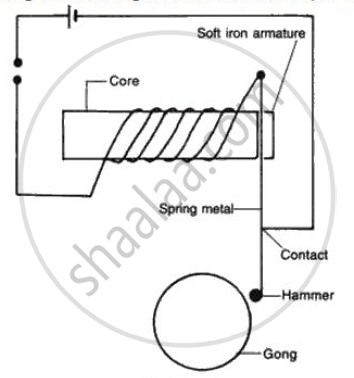
(a) Plastic
(b) Steel
(c) Copper
‘The current rating of a fuse is 5A’. Comment on this statement.
An electric bulb is marked 100 W, 230 V. What does this mean?
An electric bulb is rated as 100W – 250V. What information does it convey? Calculate the current through the filament of the bulb.
Unit of electric power may also be expressed as:
1 kWh = ______ J.
