Advertisements
Advertisements
Question
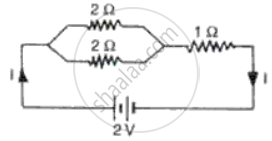
What is the current in the circuit shown (Fig. )
Advertisements
Solution
Given, potential difference, V = 2 volt
Let R be the equivalent resistance of the circuit and I be the current flowing through it; then
R = `[(1/2 + 1/2)^-1+ (1)]`
R = [1 + 1] = 2 Ω
`therefore "I" = "V"/"R" = 2/2` = 1 A
APPEARS IN
RELATED QUESTIONS
Which quantity has the unit of watt?
What is the maximum power in kilowatts of the appliance that can be connected safely to a 13 A ; 230 V mains socket?
Two resistors A and B of 4 Ω and 6 Ω respectively are connected in parallel. The combination is connected across a 6 volt battery of negligible resistance. Calculate the power supplied by the battery.
Define Kilo watt hour.
Express watt hour and kilowatt hour in joule.
What is electric power? State and define its S.I. unit.
Why is heating coil wound in the form of a helix in electric stove?
What do you understand by ‘earthing’? What are the advantages of earthing in a household electric circuit? Explain, how it is done?
An electric heater is rated 220 V, 550 W. Calculate the electrical energy consumed in 3 hours?
At what voltage is the electric power generated at the generating station? Explain the transmission of this power to your house.
