Advertisements
Advertisements
Question
Household wiring for lamp connections can either be done in parallel or in series.Which one would you prefer? Give a reason for your answer.
Advertisements
Solution
We would prefer the parallel wiring. This is done for the following reasons:
(i) In parallel wiring, each lamp can have its independent switch and the disconnection (putting off) of one of them will not effect the other lamps.
(ii) All lamps have the same potential difference (equal to that of the mains) across the terminals and are thus able to work as per their specified rating.
RELATED QUESTIONS
Which one has a higher electrical resistance : a 100 watt bulb or a 60 watt bulb?
An electric heater is rated at 2 kW. Electrical energy costs Rs 4 per kWh. What is the cost of using the heater for 3 hours?
(a) Rs 12
(b) Rs 24
(c) Rs 36
(d) Rs 48
Write the SI units for:
(a) Electric current
(b) Potential difference
(c) Charge.
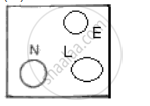
The diagram 31 shows a 3 terminal plug socket.
(i) What is the purpose of the terminal E?
(ii) To which part of the appliance is the terminal E connected?
(iii) To which wire L or N, is the fuse connected and why?
Tick(✓) the correct choice in the following:
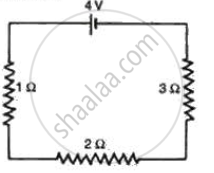
In the circuit shown in the following fig, the e.m.f. of the cell is 4 volts, the current
flowing through the resistor is
Define electric power. An electrical device of resistance R is connected across a source of voltage V and draws a current I. Derive an expression for power in terms of current and resistance.
Three 250 W heaters are connected in parallel to a 100 V supply, Calculate the energy supply in kWh to the three heaters in 5 hour.
The resistance of filament of an electric heater is 500 Ω It is operated at 200V for 1 hour daily. Calculate the current drawn by the heater and the energy consumed in joule.
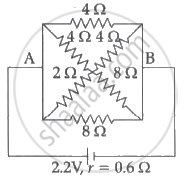
In the given figure, the emf of the cell is 2.2 V, and if internal resistance is 0.6 Ω. Calculate the power dissipated in the whole circuit.