Advertisements
Advertisements
प्रश्न
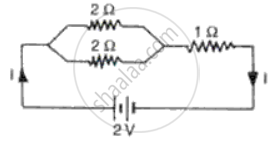
What is the current in the circuit shown (Fig. )
Advertisements
उत्तर
Given, potential difference, V = 2 volt
Let R be the equivalent resistance of the circuit and I be the current flowing through it; then
R = `[(1/2 + 1/2)^-1+ (1)]`
R = [1 + 1] = 2 Ω
`therefore "I" = "V"/"R" = 2/2` = 1 A
APPEARS IN
संबंधित प्रश्न
An electric motor takes 5 amperes current form a 220 volt supply line. Calculate the power of the motor and electric energy consumed by it in 2 hours.
Calculate the cost of operating a heater of 500 W for 20 hours at the rate of Rs 3.90 per unit.
Which of the following is the most likely temperature of the filament of an electric light bulb when it is working on the normal 220 V supply line?
(a) 500°C
(b) 1500°C
(c) 2500°C
(d) 4500°C
When a current I flows through a resistance R for time t, the electrical energy spent is given by:
(a) IRt (b) I²Rt (c) `IR^2t` (d) `I^2R ⁄t`
What is the resistance, under normal working conditions of a 240 V electric lamp rated at 60 W? If two such lamps are connected in series across a 240 V mains supply, explain why each one appears less bright.
Define electric power. An electrical device of resistance R is connected across a source of voltage V and draws a current I. Derive an expression for power in terms of current and resistance.
An Electric bulb is marked 100 W, 230 V. What current does it take?
A electric bulb is rate 220 V, 60 W. its electric cell resistance is nearly
Using a long extension cord in which each conductor has a resistance of 8Ω, a bulb marked as '100 W, 200 V' is connected to a 220 V dc supply of negligible internal resistance as shown in the figure. The power delivered to the bulb is ______ W.

