Advertisements
Advertisements
प्रश्न
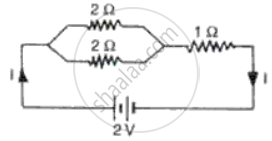
What is the current in the circuit shown (Fig. )
Advertisements
उत्तर
Given, potential difference, V = 2 volt
Let R be the equivalent resistance of the circuit and I be the current flowing through it; then
R = `[(1/2 + 1/2)^-1+ (1)]`
R = [1 + 1] = 2 Ω
`therefore "I" = "V"/"R" = 2/2` = 1 A
APPEARS IN
संबंधित प्रश्न
In a filament type light bulb, most of the electric power consumed appears as:
(a) visible light
(b) infra-red-rays
(c) ultraviolet rays
(d) fluorescent light
State and define the household unit of electricity.
List the names of three electrical gadgets used in your house. Write their power, voltage rating and approximate time for which each one is used in a day. Hence, find the electrical energy consumed by each in a day.
Express watt hour and kilowatt hour in joule.
Name three main characteristics of an heating element.
With reference to the diagram shown below calculate:

(i) The equivalent resistance between P and Q.
(ii) The reading of ammeter.
(iii) The electrical power between P and Q.
An electric iron is rated at 230 V, 750 W. What is its resistance? What maximum current can be passed through it?
If a heater coil rated lkW, 220 V is connected in series with an electric bulb of 100 W, 220 V and are supplied 200V, power consumed by the bulb in this circuit is ______.
