Advertisements
Online Mock Tests
Chapters
![Lakhmir Singh solutions for Physics [English] Class 10 ICSE chapter 2 - Work, Power and Energy - Shaalaa.com](/images/physics-english-class-10-icse_6:bfbcc704031b4fd398b72f80ee978e3f.jpg "Lakhmir Singh solutions for Physics [English] Class 10 ICSE chapter 2 - Work, Power and Energy")
Advertisements
Solutions for Chapter 2: Work, Power and Energy
Below listed, you can find solutions for Chapter 2 of CISCE Lakhmir Singh for Physics [English] Class 10 ICSE.
Lakhmir Singh solutions for Physics [English] Class 10 ICSE 2 Work, Power and Energy Intex Question [Pages 24 - 45]
THINK AND ANSWER
A max X goes to the top of a building by a vertical spiral staircase. Another man Y of the same mass goes to the top of the same building by a slanting ladder. Which of the two does more work against gravity and why?
THINK AND ANSWER
Has work been done in the following example?
A pen falls off a table, straight to the floor.
Has work been done in the following example?
A boy pushing against a locked door.
Has work been done in the following example?
A rocket accelerating through space.
Has work been done in the following example?
A cricket player hitting a ball during match.
Has work been done in the following example?
An athlete running in a circular track at the same speed.
TEST YOUR UNDERSTANDING - 1
Define work.
State the SI unit of work.
Write the formula for the work done on a body when a force acts on the body in the direction of its displacement. Give the meaning of each symbol which occurs in the formula.
Define 1 joule of work.
What are the S.I. and C.G.S units of work? How are they related? Establish the relationship.
Is it possible that a force is acting on a body but still the work done is zero? Explain giving one example.
Give one example in which a force does positive work.
Give one example in which a force does negative work.
Give one example in which a force does zero work.
What will be the work done when a man stands with a 5-kg load on his head for 20 min? Explain.
What are the quantities on which the amount of work done depends? How are they related to work?
Define power.
Mention the relationship between horsepower and the SI unit of power.
What should be the angle between the direction of force and the direction of motion of a body so that the work done is zero?
How much work is done by the gravitational force of earth acting on a satellite moving around it in a circular path? Give reason for your answer.
State whether the work done in the following case is positive or negative.
Lifting a box through a height.
State whether the work done in the following case is positive or negative.
Work done by friction when a person walks on the ground.
How is work done by a force measured when the force is in the direction of displacement?
How is work done by a force measured when the force is in an angle to the direction of displacement?
A girl is carrying a school bag of 3 kg mass on her back and moves 200 m on a levelled road. If the value of g be 10 m s−2, what will be the work done by the girl against the gravitational force?
If a boy weighing 400 N climbs a vertical ladder, what will be the work done by him after climbing 2 m? (Consider value of g as 10 m s−2.)
THINK AND ANSWER
How do we use energy in our daily activities? Does our body functions need energy?
THINK AND ANSWER
How does wind move the large blades of a windmill? Does the windmill work on the principle of mechanical energy?
THINK AND ANSWER
Why does a blacksmith use a heavier hammer than the one used by a goldsmith? On approaching a hill, why does the driver of the car increase its speed? Are reasons for these two conditions the same?
THINK AND ANSWER
When a ball is thrown inside a moving bus, does its kinetic energy depend on the speed of the bus? Explain.
TEST YOUR UNDERSTANDING - 2
Define the term energy.
State the S.I. unit of energy.
Name the different types of energy and give examples.
Explain the types of mechanical energy.
By how much will the kinetic energy of a body increase if its speed is doubled?
Write the energy transformations which take place in an electric bulb (or electric lamp).
What do you understand by the term “conversion of energy”? Explain with an example.
A body is thrown vertically upwards. Its velocity keeps on decreasing. What happens to its kinetic energy as its velocity becomes zero?
Derive the relation between commercial unit of energy (kWh) and SI unit of energy (joule).
The hanging bob of a simple pendulum is displaced to one extreme position B and then released. It swings towards centre position A and then to the other extreme position C. In which position does the bob have :
(i) maximum potential energy?
(ii) maximum kinetic energy?
State and explain the law of conservation of energy with an example.
A body of mass 0.2 kg falls from a height of 10 m to a height of 6 m above the ground. Find the loss in potential energy taking place in the body. [g = 10ms−2]
To what height should a box of mass 150 kg be lifted, so that its potential energy may become 7350 joules? (g = 9.8 m/s2)
Lakhmir Singh solutions for Physics [English] Class 10 ICSE 2 Work, Power and Energy EXERCISE [Pages 47 - 51]
Objective Questions
True or False.
The work done on an object does not depend on the displacement.
True or False.
The work done by the gravitational force on a body is always negative.
True or False.
When a body is released from a height, its potential energy gradually changes to kinetic energy.
True or False.
The physical quantity expressed in terms of horsepower is work.
True or False.
A wound-up spring has both potential and kinetic energies.
Fill in the Blanks
Fill in the blank with suitable word :
The work done on a body moving in a circular path is __________
Fill in the blank with suitable word :
The sum of the potential and kinetic energies of a body is called __________ energy.
Fill in the blanks with suitable words:
When a ball is thrown upwards, ___________ energy is transformed into ___________ energy.
Power is a ______ quantity.
The SI unit of work is ______.
Multiple Choice Questions
The work done is positive when displacement is ______.
in the direction of force
in the direction opposite to force
zero
normal to the direction of force
In the case of negative work, the angle between the force and displacement is
0°
45°
90°
180°
Water stored in a dam possesses ______.
no energy
electrical energy
kinetic energy
potential energy
While burning coal, chemical energy gets converted into ______.
thermal energy
mechanical energy
solar energy
sound energy
If acceleration due to gravity, g is 9.8 m/s2, the potential energy of a body of mass 2 kg at a height of 5 m will be:
95 J
9.8 J
90 J
98 J
Which of the following conversions is correct?
1 J = 107 erg
1 J = 106 erg
1 J = 108 erg
1 J = 109 erg
An eagle flying in the sky has ______.
only potential energy
only kinetic energy
both kinetic and potential energies
no energy
28000 J of energy is supplied by a diesel engine in 20 s. What will be the power of the engine?
1000 W
1400 W
1500 W
5600 W
Which of the following energy change involves frictional force?
chemical energy to heat energy
kinetic energy to heat energy
potential energy to sound energy
chemical energy to kinetic energy
How much energy does a 100 W electric bulb transfer in 1 minute?
100 J
600 J
3600 J
6000 J
Match the items in Column I with those in Column II and choose the appropriate code.
| Column I | Column II |
| A. Power | (i) Newton |
| B. Energy | (ii) Joule |
| C. Work | (iii) Watt |
| D. Force | (iv) Kilowatt hour |
A - (iii), B - (ii), C - (i), D - (iv)
A - (iii), B - (iv), C - (ii), D - (i)
A - (iv), B - (iii), C - (ii), D - (i)
A - (iii), B - (i), C - (ii), D - (iv)
Descriptive Questions Short Answer Questions
When does a force do work?
What is the work done by the moon when it revolves around the earth?
Explain briefly why the work done by a fielder when he takes a catch in a cricket match is negative.
What will be the angle between force and displacement to attain minimum work?
What will be the angle between force and displacement to attain maximum work?
Differentiate between work and power.
State the amount of work done by an object when it moves in a circular path for one complete rotation. Give a reason to justify your answer.
Differentiate between energy and power.
What kind of energy is possessed by the following?
A stone kept on roof-top _______________
What kind of energy is possessed by the following?
A running car ____________
What kind of energy is possessed by the following?
Water stored in the reservoir of a dam __________.
What kind of energy is possessed by the following?
A compressed spring ____________.
What kind of energy is possessed by the following?
A stretched rubber band _____________
What kind of energy is possessed by the following?
A moving bullet
What kind of energy is possessed by the following?
A bent bow
Differentiate between the potential energy (U) and the kinetic energy (K).
State different forms of potential energy and give one example of each.
Define kilowatt-hour.
Derive the relation between commercial unit of energy (kWh) and SI unit of energy (joule).
Explain with examples the different types of kinetic energy.
A man having a box on his head, climbs up a slope and another man having an identical box walks the same distance on a levelled road.
Who does more work against the force of gravity and why?
Mention the relationship between horsepower and the SI unit of power.
What will be the work done by electrons moving around the nucleus in an atom? Explain.
State the energy changes in the following case while in use:
An electric iron
State the energy changes in the following case while in use:
A ceiling fan
Name the energy conversion that takes place in case of photosynthesis.
Name the energy conversion that takes place in case of respiration.
State the condition of positive work.
State the condition of negative work.
State the condition of zero work.
What will be the work done when force is applied at an angle? Explain with appropriate diagram.
A ball is placed on a compressed spring. As the spring is released, the ball is observed to fly away. Why does that happen? What form of energy does the compressed spring possess?
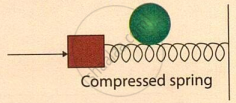
State the energy in the following while in use:
A steam engine
State the energy in the following while in use:
Burning of a candle
Long Answer Questions
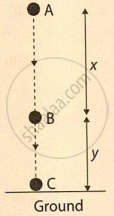
An object of mass ‘m’ is allowed to fall freely from point A as shown in the figure. Calculate the total mechanical energy of the object at:
- Point A
- Point B
- Point C
- State the law which is verified by your calculations in parts (i), (ii) and (iii).
Name the energy transfers which occur when an electric ball rings.
Name the energy transfers which occur when someone speaks into a microphone.
Name the energy transfers which occur when there is a picture on a television screen.
Name the energy transfers which occur when a torch is on.
Name the energy conversion that takes place when we rub the palms of our hands together.
Show that for the free fall of a body, the sum of the mechanical energy at any point in its path is constant.
Give two examples of the following energy conversion.
Heat energy to mechanical energy.
Give two examples of the following energy conversion.
Electrical energy to chemical energy.
Give two examples of the following energy conversion.
Chemical energy to heat energy.
Give two examples of the following energy conversion.
Light energy to heat energy.
Give two examples of the following energy conversion.
Heat energy to electrical energy.
Numerical Problems
The work done by the heart is 1 Joule per beat. Calculate the power of the heart if it beats 72 times in one.
Two bodies have masses in the ratio 5 : 1 and their kinetic energies are in the ratio 125 : 9. Calculate the ratio of their velocities.
The momentum of a bullet of mass 20 g fired from a gun is 10 kg m/s. What will be the kinetic energy of this bullet in kJ?
A boy of mass 50 kg climbs up the stairs and reaches the roof at a height of 10 m in 20 s. Calculate (i) the force of gravity acting on the boy, (ii) the work done by him against the force of gravity and (iii) the power spent by the boy. (Consider g = 10 ms−2.)
A moving body weighing 400 N possesses 500 J of kinetic energy. Calculate the velocity with which the body is moving. (g = 10 ms2)
A boy weighing 40 kg carries a box weighing 20 kg to the top of a building 15 m high in 25 seconds. Calculate the power. (g = 10 m/s2)
A simple pendulum of mass 300 g is shown in the figure. The pendulum bob is displaced from the mean position A to the extreme position B. The potential energy at position A is zero. At the position B, the pendulum bob is raised by 10 m.
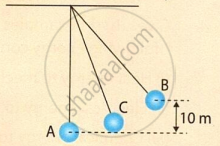
- Calculate the potential energy of the pendulum at position B.
- Calculate the total mechanical energy at position С.
- Determine the speed of the pendulum bob at position A when released from position B.
Consider g = 10 m/s2 and there is no loss of energy.
Calculate the speed of a moving proton whose kinetic energy is 5 MeV. The mass of the proton is 1.6 × 10⁻²⁷ kg and 1 MeV = 1.6 × 10⁻¹³ J.
In a waterfall of height 100 m, 2000 kg of water falls per second. Calculate the potential energy of water at its initial position. Determine the final kinetic energy of water on the ground.
A ball of mass 0.20 kg is thrown vertically upwards with an initial velocity of 20 m s-1. Calculate the maximum potential energy it gains as it goes up.
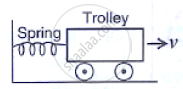
A spring is kept compressed by a small trolley of mass 0.5 kg lying on a smooth horizontal surface as shown in the adjacent fig. When the trolley is released, it is found to move at a speed v = 2 m s-1. What potential energy did the spring possess when compressed?
The power of a motor is 40 kW. At what speed can the motor raise a load of 20,000 N?
A stone of mass 64.0 g is thrown vertically upward from the ground with an initial speed of 20.0 m/s. The gravitational potential energy at the ground level is considered to be zero. Apply the principle of conservation of energy and calculate the potential energy at the maximum height attained by the stone (g = 10 m s−2).
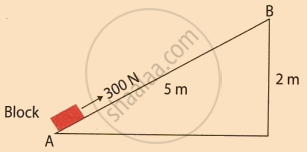
A block of mass 40 kg is pulled up a slope with a constant speed by applying a force of 300 N parallel to the slope as shown in the figure. A and B are initial and final positions of the block, respectively.
- Calculate the work done by force in moving the block from position A to position B.
- Calculate the potential gained by the block.
(Consider g = 10 m/s2.)
In loading a truck, a man lifts boxes of 100 N each through a height of 1.5 m. (g = 10 m s−2)
- How much work does he do in lifting one box?
- How much energy is transferred when one box is lifted?
- If the man lifts 4 boxes per minute, at what power is he working?
A bullet of mass 15 g has a speed of 400 m/s. What is its kinetic energy? If the bullet strikes a thick target and is brought to rest in 2 cm, calculate the average net force acting on the bullet. What happens to the kinetic energy originally in the bullet?
DO IT RIGHT
|
Raghav who weighs 55 kg records the time taken by him in running up a flight of steps on a staircase. He then measures the height of each step. He also counts the number of steps on the staircase. Following are his observations:
|
- How much is the work done by Raghav?
- What will be his power?
- If Raghav’s friend, Ravi who weighs 50 kg runs up the stairs and takes the same time to reach the final position, who does the most work and develops the most power?
- If another friend, Sameer who weighs the same as Raghav runs up the stairs in 10 s, who does the most work and develops the most power among the three friends?
Solutions for 2: Work, Power and Energy
Lakhmir Singh solutions for Physics [English] Class 10 ICSE chapter 2 - Work, Power and Energy
Shaalaa.com has the CISCE Mathematics Physics [English] Class 10 ICSE CISCE solutions in a manner that help students grasp basic concepts better and faster. The detailed, step-by-step solutions will help you understand the concepts better and clarify any confusion. Lakhmir Singh solutions for Mathematics Physics [English] Class 10 ICSE CISCE 2 (Work, Power and Energy) include all questions with answers and detailed explanations. This will clear students' doubts about questions and improve their application skills while preparing for board exams.
Further, we at Shaalaa.com provide such solutions so students can prepare for written exams. Lakhmir Singh textbook solutions can be a core help for self-study and provide excellent self-help guidance for students.
Concepts covered in Physics [English] Class 10 ICSE chapter 2 Work, Power and Energy are .
Using Lakhmir Singh Physics [English] Class 10 ICSE solutions Work, Power and Energy exercise by students is an easy way to prepare for the exams, as they involve solutions arranged chapter-wise and also page-wise. The questions involved in Lakhmir Singh Solutions are essential questions that can be asked in the final exam. Maximum CISCE Physics [English] Class 10 ICSE students prefer Lakhmir Singh Textbook Solutions to score more in exams.
Get the free view of Chapter 2, Work, Power and Energy Physics [English] Class 10 ICSE additional questions for Mathematics Physics [English] Class 10 ICSE CISCE, and you can use Shaalaa.com to keep it handy for your exam preparation.
