Advertisements
Advertisements
Question
Water stored in a dam possesses ______.
Options
no energy
electrical energy
kinetic energy
potential energy
Advertisements
Solution
Water stored in a dam possesses potential energy.
Explanation:
Water stored at a height (in a dam or tank) possesses gravitational potential energy due to its raised position above the ground.
APPEARS IN
RELATED QUESTIONS
Does the transfer of energy take place when you push a huge rock with all your might and fail to move it? Where is the energy you spend going?
State the condition under which the mechanical energy is conserved.
A metal ball of mass 2 kg is allowed to fall freely from rest from a height of 5 m above the ground. Taking g = 10 m s−2, calculate:
- the potential energy possessed by the ball when it is initially at rest.
- the kinetic energy of the ball just before it hits the ground?
State whether the object possess kinetic energy, potential energy, or both :
A flying aeroplane _______________.
State whether the object possess kinetic energy, potential energy, or both :
A stretched spring lying on the ground ____________.
What type of energy is possessed : by the piece of stone which is thrown away on releasing the stretched rubber strings of catapult?
What are the various forms of energy?
Two bodies having equal masses are moving with uniform speeds of v and 2v respectively. Find the ratio of their kinetic energies.
Name the device or machine which convert :
Mechanical energy into electrical energy.
Name the device or machine which convert :
Electrical energy into heat energy.
Name the device or machine which convert :
Chemical energy into kinetic energy (or mechanical energy).
How much electrical energy in joules does a 100 watt lamp consume : in 1 second?
A bulb lights up when connected to a battery. State the energy change which takes place :
The hanging bob of a simple pendulum is displaced to one extreme position B and then released. It swings towards centre position A and then to the other extreme position C. In which position does the bob have :
(i) maximum potential energy?
(ii) maximum kinetic energy?
Explain the transformation of energy in the following cases :
(i) A ball thrown upwards.
(ii) A stone dropped from the roof of a building.
A ball falls to the ground as shown below :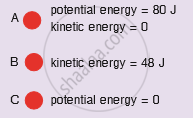
What is the kinetic energy of ball when it hits the ground?
A ball falls to the ground as shown below :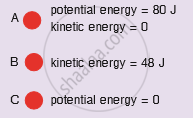
Which law you have made use of in answering this question?
When an object falls freely towards the earth, then its total energy :
In the case of negative work, the angle between the force and displacement is
A girl is carrying a school bag of 3 kg mass on her back and moves 200 m on a levelled road. The work done against the gravitational force will be (g = 10 m s–2)
