Advertisements
Advertisements
Question
Two bodies having equal masses are moving with uniform speeds of v and 2v respectively. Find the ratio of their kinetic energies.
Advertisements
Solution
Let the masses of the two bodies be (m1) = m kg and (m2) = m kg .
Velocity of the first body, (v1) = v m/s
Velocity of the first body, (v2) = 2v m/s
The required ratio is-
= `"(Kinetic energy)"_1/"(Kinetic energy)"_2`
= `(1/2 (m_1)(v_1)^2)/(1/2 (m_2)(v_2)^2)`
So put the values to get ,
= `(1)^2/(2)^2`
= `1/4`
The ratio of K.E is, K.E of body 1 : K.E of body 2 = 1 : 4.
APPEARS IN
RELATED QUESTIONS
Show that the sum of kinetic energy and potential energy (i.e., total mechanical energy) is always conserved in the case of a freely falling body under gravity (with air resistance neglected) from a height h by finding it when
- The body is at the top.
- the body has fallen a distance x.
- the body has reached the ground.
What type of energy is possessed : by the stretched rubber strings of a catapult?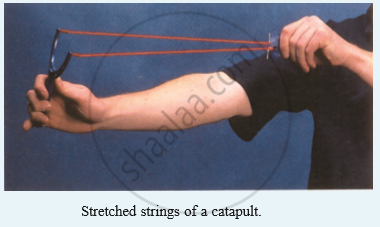
Define the term 'energy' of a body. What is the SI unit of energy.
What are the various forms of energy?
What is the difference between potential energy and kinetic energy?
A stone is thrown upwards as shown in the diagram. When it reaches P, which of the following has the greatest value of the stone?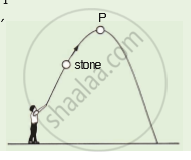
Name the device or machine which convert :
Chemical energy into electrical energy.
Name the device or machine which convert :
Electrical energy into light energy.
What do you understand by the term 'transformation of energy"? Explain with an example.
Name the energy transfers which occur when someone speaks into a microphone.
