Advertisements
Advertisements
Question
When an object falls freely towards the earth, then its total energy :
Options
increases
decreases
remains constant
first increases and then decreases
Advertisements
Solution
Total energy of a freely falling object remains conserved.
Therefore the answer is, (c) Remains constant
APPEARS IN
RELATED QUESTIONS
Does the transfer of energy take place when you push a huge rock with all your might and fail to move it? Where is the energy you spend going?
A ball of mass 0.20 kg is thrown vertically upwards with an initial velocity of 20 m s-1. Calculate the maximum potential energy it gains as it goes up.
A metal ball of mass 2 kg is allowed to fall freely from rest from a height of 5 m above the ground. Taking g = 10 m s−2, calculate:
- the potential energy possessed by the ball when it is initially at rest.
- the kinetic energy of the ball just before it hits the ground?
State whether the object possess kinetic energy, potential energy, or both :
A bird running on the ground ____________.
Define the term 'energy' of a body. What is the SI unit of energy.
Name the device or machine which convert :
Mechanical energy into electrical energy.
Fill in the blanks with suitable words:
When a ball is thrown upwards, ___________ energy is transformed into ___________ energy.
Name the energy transfers which occur when someone speaks into a microphone.
A ball falls to the ground as shown below :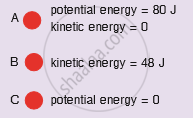
What is the kinetic energy of ball when it hits the ground?
A girl with having a mass of 35 kg sits on a trolley of mass 5 kg. The trolley is given an initial velocity of 4 m s–1 by applying a force. The trolley comes to rest after traversing a distance of 16 m. (a) How much work is done on the trolley? (b) How much work is done by the girl?
