Advertisements
Advertisements
Question
A girl with having a mass of 35 kg sits on a trolley of mass 5 kg. The trolley is given an initial velocity of 4 m s–1 by applying a force. The trolley comes to rest after traversing a distance of 16 m. (a) How much work is done on the trolley? (b) How much work is done by the girl?
Advertisements
Solution
Effective mass of girl + trolley system = mass of girl + mass of trolley = 35 kg + 5 kg = 40 kg
Here, u = 4 10m s−1, v – 0, s = 16 m
Using v2 – u2= 2as, we get
a = `("v"^2 - "u"^2)/(2"s")`
= `(0 - 4^2)/(2 xx 16)`
= `(-1)/2 "m s"^-2`
∴ Force, F = ma = `40 xx ((-1)/2)"N"`
= −20N
(a) Work done on the trolley = – Work done by the trolley
= − Fs
= – (–20 N) × (16 m)
= 320 J
(b) As the girl keeps sitting on the trolley, there is no displacement in her position with respect to the trolley, so no work is done by the girl.
APPEARS IN
RELATED QUESTIONS
A ball is placed on a compressed spring. What form of energy does the spring possess? On releasing the spring, the ball flies away. Give a reason.
In what way does the temperature of water at the bottom of a waterfall differ from the temperature at the top? Explain the reason.
Show that the sum of kinetic energy and potential energy (i.e., total mechanical energy) is always conserved in the case of a freely falling body under gravity (with air resistance neglected) from a height h by finding it when
- The body is at the top.
- the body has fallen a distance x.
- the body has reached the ground.
Define the term 'energy' of a body. What is the SI unit of energy.
What is the difference between potential energy and kinetic energy?
How much electric energy in kWh is consumed by an electrical appliance of 1000 watts when it is switched on for 60 minutes?
A ball falls to the ground as shown below :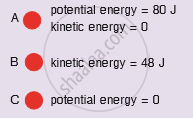
What is the potential energy of ball at B?
An object is falling freely from a height x. After it has fallen a height `pi/2` , it will possess :
In the case of negative work, the angle between the force and displacement is
A body of mass 10 kg falls from a height of 20 m to 8 m. Calculate:
- the loss in potential energy of the body, and
- the total energy possessed by the body at any instant? (Take g = 10 m s-2)
