Advertisements
Advertisements
प्रश्न
A girl with having a mass of 35 kg sits on a trolley of mass 5 kg. The trolley is given an initial velocity of 4 m s–1 by applying a force. The trolley comes to rest after traversing a distance of 16 m. (a) How much work is done on the trolley? (b) How much work is done by the girl?
Advertisements
उत्तर
Effective mass of girl + trolley system = mass of girl + mass of trolley = 35 kg + 5 kg = 40 kg
Here, u = 4 10m s−1, v – 0, s = 16 m
Using v2 – u2= 2as, we get
a = `("v"^2 - "u"^2)/(2"s")`
= `(0 - 4^2)/(2 xx 16)`
= `(-1)/2 "m s"^-2`
∴ Force, F = ma = `40 xx ((-1)/2)"N"`
= −20N
(a) Work done on the trolley = – Work done by the trolley
= − Fs
= – (–20 N) × (16 m)
= 320 J
(b) As the girl keeps sitting on the trolley, there is no displacement in her position with respect to the trolley, so no work is done by the girl.
APPEARS IN
संबंधित प्रश्न
A stone of mass 500 g is thrown vertically upwards with a velocity of 15 m/s. Calculate:
- the potential energy at the greatest height,
- the kinetic energy on reaching the ground, and
- the total energy at its half-way point.
Define the term 'energy' of a body. What is the SI unit of energy.
Name the device which converts electrical energy into mechanical energy.
Name the device or machine which convert :
light energy into heat energy.
A bulb lights up when connected to a battery. State the energy change which takes place :
Explain the transformation of energy in the following cases :
(i) A ball thrown upwards.
(ii) A stone dropped from the roof of a building.
What is the meaning of the symbol kWh? What quantity does it represent?
A ball falls to the ground as shown below :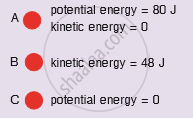
What is the potential energy of ball at B?
An object is falling freely from a height x. After it has fallen a height `pi/2` , it will possess :
The device which converts mechanical energy into energy which runs our microwave oven is :
