Advertisements
Advertisements
प्रश्न
Explain the transformation of energy in the following cases :
(i) A ball thrown upwards.
(ii) A stone dropped from the roof of a building.
Advertisements
उत्तर
(i) When a ball is thrown upwards, its kinetic energy at the thrower's hand is transformed into potential energy at the maximum height. As the stone continues to move upwards, its potential energy gradually increases, but its kinetic energy decreases as velocity of the stone decreases.
(ii) When a stone is dropped from a height its potential energy at the height is transformed into kinetic energy on reaching the ground. As the stone descends, its potential energy gradually decreases and its kinetic energy increases.
APPEARS IN
संबंधित प्रश्न
A ball is placed on a compressed spring. What form of energy does the spring possess? On releasing the spring, the ball flies away. Give a reason.
In what way does the temperature of water at the bottom of a waterfall differ from the temperature at the top? Explain the reason.
State whether the object possess kinetic energy, potential energy, or both :
A man climbing a hill _____________.
A boy weighing 40 kg makes a high jump of 1.5 m.
What is his potential energy at the highest point? (g = 10 m/s2)
What do you understand by the term 'transformation of energy"? Explain with an example.
Name the energy transfers which occur when someone speaks into a microphone.
A ball falls to the ground as shown below :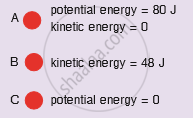
Which law you have made use of in answering this question?
Which of the following energy change involves frictional force?
A microphone converts :
A girl is carrying a school bag of 3 kg mass on her back and moves 200 m on a levelled road. The work done against the gravitational force will be (g = 10 m s–2)
