Advertisements
Advertisements
प्रश्न
Explain the transformation of energy in the following cases :
(i) A ball thrown upwards.
(ii) A stone dropped from the roof of a building.
Advertisements
उत्तर
(i) When a ball is thrown upwards, its kinetic energy at the thrower's hand is transformed into potential energy at the maximum height. As the stone continues to move upwards, its potential energy gradually increases, but its kinetic energy decreases as velocity of the stone decreases.
(ii) When a stone is dropped from a height its potential energy at the height is transformed into kinetic energy on reaching the ground. As the stone descends, its potential energy gradually decreases and its kinetic energy increases.
APPEARS IN
संबंधित प्रश्न
Does the transfer of energy take place when you push a huge rock with all your might and fail to move it? Where is the energy you spend going?
Show that the sum of kinetic energy and potential energy (i.e., total mechanical energy) is always conserved in the case of a freely falling body under gravity (with air resistance neglected) from a height h by finding it when
- The body is at the top.
- the body has fallen a distance x.
- the body has reached the ground.
Fill in the blank with suitable word :
The sum of the potential and kinetic energies of a body is called __________ energy.
What type of energy is possessed : by the piece of stone which is thrown away on releasing the stretched rubber strings of catapult?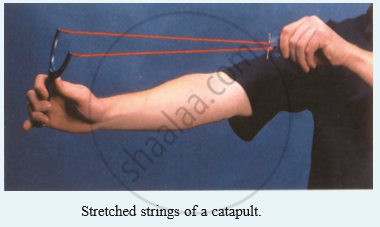
A stone is thrown upwards as shown in the diagram. When it reaches P, which of the following has the greatest value of the stone?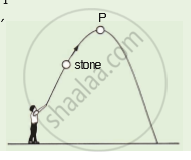
Fill in the blanks with suitable words :
The principle of ___________ of energy says energy can be transformed from one form to another, but it cannot be ___________ or ___________.
Name the energy transfers which occur when there is a picture on a television screen.
How much energy does a 100 W electric bulb transfer in 1 minute?
In the case of negative work, the angle between the force and displacement is
An automobile engine propels a 1000 kg car (A) along a levelled road at a speed of 36 km h–1. Find the power if the opposing frictional force is 100 N. Now, suppose after travelling a distance of 200 m, this car collides with another stationary car (B) of the same mass and comes to rest. Let its engine also stop at the same time. Now the car (B) starts moving on the same level road without getting its engine started. Find the speed of the car (B) just after the collision.
