Advertisements
Advertisements
Question
A ball falls to the ground as shown below :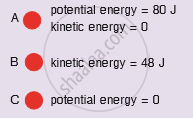
What is the potential energy of ball at B?
Advertisements
Solution
Total energy of a free falling object remains conserved.
So,
Total energy at A = Total energy at B
So,
(K.E)A + (P.E)A = (K.E)B + (P.E)B
Thus
Total energy at A = (K.E)B + (P.E)B
Therefore,
(P.E)B = (80 – 48) J= 32 J
APPEARS IN
RELATED QUESTIONS
Does the transfer of energy take place when you push a huge rock with all your might and fail to move it? Where is the energy you spend going?
State the condition under which the mechanical energy is conserved.
A boy weighing 40 kg makes a high jump of 1.5 m.
What is his kinetic energy at the highest point?
Name the device or machine which convert :
Chemical energy into electrical energy.
Name the device or machine which convert :
Electrical energy into light energy.
What kind of energy transformations take place at a coal-based thermal power station?
Describe the energy changes which take place in a radio.
Which of the following energy change involves frictional force?
An object is falling freely from a height x. After it has fallen a height `pi/2` , it will possess :
In the case of negative work, the angle between the force and displacement is
