Advertisements
Advertisements
प्रश्न
A ball falls to the ground as shown below :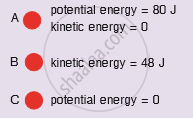
What is the potential energy of ball at B?
Advertisements
उत्तर
Total energy of a free falling object remains conserved.
So,
Total energy at A = Total energy at B
So,
(K.E)A + (P.E)A = (K.E)B + (P.E)B
Thus
Total energy at A = (K.E)B + (P.E)B
Therefore,
(P.E)B = (80 – 48) J= 32 J
APPEARS IN
संबंधित प्रश्न
Does the transfer of energy take place when you push a huge rock with all your might and fail to move it? Where is the energy you spend going?
Show that the sum of kinetic energy and potential energy (i.e., total mechanical energy) is always conserved in the case of a freely falling body under gravity (with air resistance neglected) from a height h by finding it when
- The body is at the top.
- the body has fallen a distance x.
- the body has reached the ground.
Is energy a vector quantity?
State whether the object possess kinetic energy, potential energy, or both :
A ceiling fan in the off position ______________
What kind of energy is possessed by the following?
Water stored in the reservoir of a dam __________.
Water stored in a dam possesses ______.
Fill in the blanks with suitable words:
When a ball is thrown upwards, ___________ energy is transformed into ___________ energy.
Name the energy transfers which occur when someone speaks into a microphone.
How much energy does a 100 W electric bulb transfer in 1 minute?
An automobile engine propels a 1000 kg car (A) along a levelled road at a speed of 36 km h–1. Find the power if the opposing frictional force is 100 N. Now, suppose after travelling a distance of 200 m, this car collides with another stationary car (B) of the same mass and comes to rest. Let its engine also stop at the same time. Now the car (B) starts moving on the same level road without getting its engine started. Find the speed of the car (B) just after the collision.
