Advertisements
Advertisements
प्रश्न
A ball falls to the ground as shown below :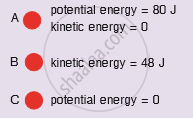
What is the potential energy of ball at B?
Advertisements
उत्तर
Total energy of a free falling object remains conserved.
So,
Total energy at A = Total energy at B
So,
(K.E)A + (P.E)A = (K.E)B + (P.E)B
Thus
Total energy at A = (K.E)B + (P.E)B
Therefore,
(P.E)B = (80 – 48) J= 32 J
APPEARS IN
संबंधित प्रश्न
State whether the object possess kinetic energy, potential energy, or both :
A stretched spring lying on the ground ____________.
What kind of energy is possessed by the following?
Water stored in the reservoir of a dam __________.
A boy weighing 40 kg makes a high jump of 1.5 m.
What is his kinetic energy at the highest point?
Name the device or machine which convert :
Chemical energy into kinetic energy (or mechanical energy).
Five electric fans of 120 watts each are used for 4 hours. Calculate the electrical energy consumed in kilowatt-hours.
What do you understand by the term 'transformation of energy"? Explain with an example.
Explain the transformation of energy in the following cases :
(i) A ball thrown upwards.
(ii) A stone dropped from the roof of a building.
Name the energy transfers which occur when an electric ball rings.
Name the energy transfers which occur when there is a picture on a television screen.
Name the energy transfers which occur when a torch is on.
