Advertisements
Advertisements
Question
In the case of negative work, the angle between the force and displacement is
Options
0°
45°
90°
180°
Advertisements
Solution
180°
Explanation:
Work done is negative when a force acts opposite to the direction of displacement, i.e. the angle between the two directions is 180°.
RELATED QUESTIONS
Does the transfer of energy take place when you push a huge rock with all your might and fail to move it? Where is the energy you spend going?
A ball is placed on a compressed spring. What form of energy does the spring possess? On releasing the spring, the ball flies away. Give a reason.
A body falls freely under gravity from rest. Name the kind of energy it will possess while falling.
A ball of mass 0.20 kg is thrown vertically upwards with an initial velocity of 20 m s-1. Calculate the maximum potential energy it gains as it goes up.
Is energy a vector quantity?
State whether the object possess kinetic energy, potential energy, or both :
A ceiling fan in the off position ______________
Fill in the blank with suitable word :
The ability of a body to do work is called __________. The ability of a body to do work because of its motion is called __________.
A boy weighing 40 kg makes a high jump of 1.5 m.
What is his potential energy at the highest point? (g = 10 m/s2)
Define the term 'energy' of a body. What is the SI unit of energy.
Water stored in a dam possesses ______.
Name the device or machine which convert :
Chemical energy into electrical energy.
Name the device or machine which convert :
Electrical energy into heat energy.
Name the device or machine which convert :
Electrical energy into light energy.
Fill in the blanks with suitable words :
The principle of ___________ of energy says energy can be transformed from one form to another, but it cannot be ___________ or ___________.
Describe the energy changes which take place in a radio.
How much electric energy in kWh is consumed by an electrical appliance of 1000 watts when it is switched on for 60 minutes?
A ball falls to the ground as shown below :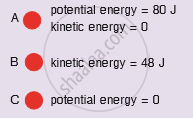
What is the potential energy of ball at B?
A ball falls to the ground as shown below :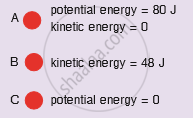
Which law you have made use of in answering this question?
Which of the following energy change involves frictional force?
A girl with having a mass of 35 kg sits on a trolley of mass 5 kg. The trolley is given an initial velocity of 4 m s–1 by applying a force. The trolley comes to rest after traversing a distance of 16 m. (a) How much work is done on the trolley? (b) How much work is done by the girl?
