Advertisements
Advertisements
Question
Show that for the free fall of a body, the sum of the mechanical energy at any point in its path is constant.
Advertisements
Solution
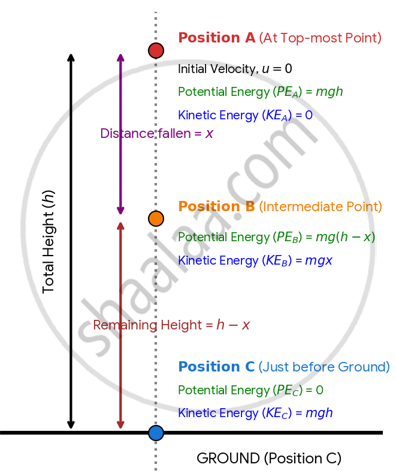
Let a body of mass m be initially at rest at point A, which is at a vertical height h from the ground. As it falls freely under gravity, it passes through an intermediate point B after traveling a distance x, and finally touches the ground at point C.
1. Total Energy at Position A (At the Top-most Point):
Vertical height from the ground = h
Since the object is at rest, its initial velocity is u = 0
Potential Energy (PEA) = mgh
Kinetic Energy (KEA) = `1/2 "mu"^2`
= `1/2 m(0)^2`
= 0
Total Mechanical Energy (EA) = PEA + KEA
= mgh + 0
= mgh ......(1)
2. Total Energy at Position B (At an Intermediate Point):
The body falls a downward distance x, so its remaining height above the ground becomes (h − x).
Let its velocity at point B be v1.
Using the equation of motion:
`v_1^2` = 0 + 2gx = 2gx
Kinetic Energy (KEB) = `1/2 mv_1^2`
= `1/2 m(2gx)`
= mgx
Potential Energy (PEB) = mg(h − x)
= mgh − mgx
Total Mechanical Energy (EB) = PEB + KEB
= (mgh − mgx) + mgx
= mgh .......(2)
3. Total Energy at Position C (Just before hitting the Ground)
Total displacement traveled = h, and its final height from the ground becomes 0.
Let its final velocity at point C be v2.
Using the equation of motion:
v2 + u2 + 2as (where total displacement s = h)
`v_2^2` = 0 + 2gh = 2gh
Kinetic Energy (KEC) = `1/2 mv_2^2`
= `1/2 m(2gh)`
= mgh
Potential Energy (PEC): Since height is zero,
PEC = mg(0) = 0
Total Mechanical Energy (EC) = PEC + KEC
= 0 + mgh
= mgh .....(3)
From Equations (1), (2), and (3), we observe that:
EA = EB = EC = mgh = Constant
As the body falls, its Potential Energy decreases while its Kinetic Energy increases by an equal amount. The sum of both mechanical energies remains completely constant throughout its path. This verifies the Law of Conservation of Mechanical Energy.
