Advertisements
Advertisements
Questions
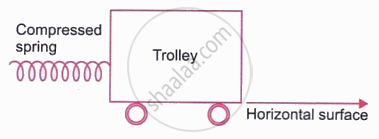
A spring is kept compressed by a small trolley of mass 0.5 kg lying on a smooth horizontal surface as shown in the adjacent fig. When the trolley is released, it is found to move at a speed v = 2 m s-1. What potential energy did the spring possess when compressed?
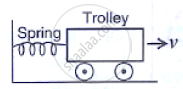
A spring is kept compressed by a toy car of mass 500 g lying on a smooth horizontal ground. On releasing the pressure, the car moves out with a speed of 2 m/s. Determine the potential energy of the compressed spring.
A toy is acted upon by a force.
A spring is kept compressed by a small trolley of mass 0.5 kg lying on a smooth horizontal surface as shown in the adjacent fig. When the trolley is released, it is found to move at a speed v = 2 m s-1. What potential energy did the spring possess when compressed?
Advertisements
Solution
Mass of trolley = 500 g = `500/1000` kg = 0.5 kg
Velocity = 2 m/s
When the compressed spring is released, its potential energy is converted into kinetic energy completely.
Potential energy of compressed spring = kinetic energy of moving trolley
Kinetic energy of trolley = `1/2 × "mass" × ("velocity")^2`
= `1/2 × 0.5 × (2)^2`
= `1/2 × 0.5 × 2 × 2`
= 1 J
Hence, the potential energy of the compressed spring is 1.0 J.
RELATED QUESTIONS
Gravitational potential energy U = mass × force of gravity on unit mass × ..........
Two bodies A and B of masses 10 kg and 20 kg respectively are at the same height above the ground. Which of the two has greater potential energy?
A bucket full of water is on the first floor of your house and another identical bucket with the same quantity of water is kept on the second floor. Which of the two has greater potential energy?
Write the expression for the gravitational potential energy explaining the meaning of the symbols used.
Two bodies of same masses are placed at heights h and 2h. Compare their gravitational potential energy.
The gravitational potential energy stored in a box of weight 150 kgf is 1.5 × 10⁴ J. Find the height of the box. Take 1 kgf = 10 N.
Define the term potential energy of a body.
A body falls freely under gravity from rest. Name the kind of energy it will possess at the point from where it falls.
A ball of mass m is thrown vertically up with an initial velocity so as to reach a height h. The correct statement is:
If we increase the velocity of a car moving on a flat surface to four times its original speed, its potential energy ______.
