Advertisements
Advertisements
प्रश्न
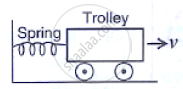
A spring is kept compressed by a small trolley of mass 0.5 kg lying on a smooth horizontal surface as shown in the adjacent fig. When the trolley is released, it is found to move at a speed v = 2 m s-1. What potential energy did the spring possess when compressed?
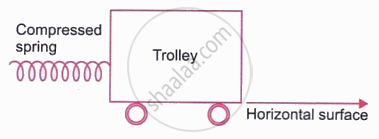
A spring is kept compressed by a toy car of mass 500 g lying on a smooth horizontal ground. On releasing the pressure, the car moves out with a speed of 2 m/s. Determine the potential energy of the compressed spring.
A toy is acted upon by a force.
A spring is kept compressed by a small trolley of mass 0.5 kg lying on a smooth horizontal surface as shown in the adjacent fig. When the trolley is released, it is found to move at a speed v = 2 m s-1. What potential energy did the spring possess when compressed?
Advertisements
उत्तर
Mass of trolley = 500 g = `500/1000` kg = 0.5 kg
Velocity = 2 m/s
When the compressed spring is released, its potential energy is converted into kinetic energy completely.
Potential energy of compressed spring = kinetic energy of moving trolley
Kinetic energy of trolley = `1/2 × "mass" × ("velocity")^2`
= `1/2 × 0.5 × (2)^2`
= `1/2 × 0.5 × 2 × 2`
= 1 J
Hence, the potential energy of the compressed spring is 1.0 J.
संबंधित प्रश्न
The potential energy of a freely falling object decreases progressively. Does this violate the law of conservation of energy? Why?
Write the expression for the gravitational potential energy explaining the meaning of the symbols used.
A body falls freely under gravity from rest. Name the kind of energy it will possess at the point from where it falls.
What happens to the potential energy of a body when its height is doubled?
A weightlifter is lifting weights of mass 200 kg up to a height of 2 metres. If g = 9.8 m s−2, calculate :
potential energy acquired by the weights.
A weightlifter is lifting weights of mass 200 kg up to a height of 2 metres. If g = 9.8 m s−2, calculate :
work done by the weightlifter
To what height should a box of mass 150 kg be lifted, so that its potential energy may become 7350 joules? (g = 9.8 m/s2)
When a ball is thrown vertically upwards, its velocity goes on decreasing. What happens to its potential energy as its velocity becomes zero?
Prove that the kinetic energy of a freely falling object on reaching the ground is nothing but the transformation of its initial potential energy.
Potential energy and heat energy are the two forms of mechanical energy.
