Advertisements
Advertisements
प्रश्न
Two bodies A and B of equal masses are kept at heights of h and 2h respectively. What will be the ratio of their potential energies?
Advertisements
उत्तर
Potential energy of a body is directly proportional to the height of the object.
Hence , `"Potential energy of A"/"Potential energy of B" = 1/2`
Ratio of A and B = 1:2
APPEARS IN
संबंधित प्रश्न
Two bodies A and B of masses 10 kg and 20 kg respectively are at the same height above the ground. Which of the two has greater potential energy?
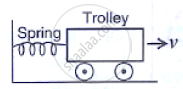
A spring is kept compressed by a small trolley of mass 0.5 kg lying on a smooth horizontal surface as shown in the adjacent fig. When the trolley is released, it is found to move at a speed v = 2 m s-1. What potential energy did the spring possess when compressed?
A ball of mass m is thrown vertically up with an initial velocity so as to reach a height h. The correct statement is:
State whether the following statement is true or false :
The potential energy of a body of mass 1 kg kept at a height of 1 m is 1 J.
A weightlifter is lifting weights of mass 200 kg up to a height of 2 metres. If g = 9.8 m s−2, calculate :
work done by the weightlifter
A boy weighing 50 kg climbs up a vertical height of 100 m. Calculate the amount of work done by him. How much potential energy does he gain? (g = 9.8 m/s2)
Explain by an example what is meant by potential energy. Write down the expression for gravitational potential energy of a body of mass m placed at a height h above the surface of the earth.
A man is instructed to carry a package from the base camp at B to summit A of a hill at a height of 1200 metres. The man weighs 800 N and the package weighs 200 N. If g = 10 m/s2,
- how much work does man do against gravity?
- what is the potential energy of the package at A if its is assumed to be zero at B?
How much energy is gained by a box of mass 20 kg when a man, raises the box by 0.5 m in order to place it inside the bus? (g=10 m/s-2)
Which of the following is the example potential energy?
