Advertisements
Advertisements
प्रश्न
Two bodies A and B of equal masses are kept at heights of h and 2h respectively. What will be the ratio of their potential energies?
Advertisements
उत्तर
Potential energy of a body is directly proportional to the height of the object.
Hence , `"Potential energy of A"/"Potential energy of B" = 1/2`
Ratio of A and B = 1:2
APPEARS IN
संबंधित प्रश्न
A bucket full of water is on the first floor of your house and another identical bucket with the same quantity of water is kept on the second floor. Which of the two has greater potential energy?
A body of mass m is moved from ground to a height h. If the force of gravity on mass of 1 kg is g newton, find the force needed to lift the body.
A body of mass m is moved from ground to a height h. If force of gravity on mass of 1 kg is g newton, find the potential energy stored in the body.
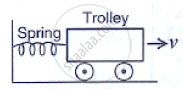
A spring is kept compressed by a small trolley of mass 0.5 kg lying on a smooth horizontal surface as shown in the adjacent fig. When the trolley is released, it is found to move at a speed v = 2 m s-1. What potential energy did the spring possess when compressed?
A body falls freely under gravity from rest. Name the kind of energy it will possess at the point from where it falls.
A weightlifter is lifting weights of mass 200 kg up to a height of 2 metres. If g = 9.8 m s−2, calculate :
potential energy acquired by the weights.
A body of mass 2 kg is thrown vertically upwards with an initial velocity of 20 m/s. What will be its potential energy at the end of 2 s? (Assume g = 10 m/s2).
Prove that the kinetic energy of a freely falling object on reaching the ground is nothing but the transformation of its initial potential energy.
If we increase the velocity of a car moving on a flat surface to four times its original speed, its potential energy ______.
Which of the following is the example potential energy?
