Advertisements
Advertisements
प्रश्न
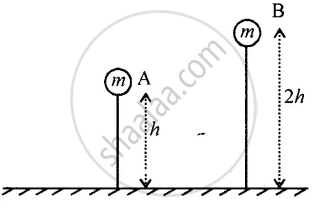
Two bodies of same masses are placed at heights h and 2h. Compare their gravitational potential energy.
Advertisements
उत्तर १
Gravitational pot. Energy of A: Gravitational pot.
energy of B = `(mgh)/(2mgh) = 1/2` = 1 : 2
उत्तर २
The gravitational potential energy (GPE) of an object is given by the formula:
GPE = mgh
Where:
- m = mass of the object
- g = acceleration due to gravity
- h = height of the object
For the two bodies:
-
First body at height h:
GPE1 = mgh -
Second body at height 2h:
GPE2 = mg (2h) = 2mgh
Ratio of their GPEs:
`(GPE_1)/(GPE_2) = (mgh)/(2mgh) = 1/2`
The gravitational potential energy of the second body is twice that of the first body. Thus, GPE2 : GPE1 = 2 : 1.
APPEARS IN
संबंधित प्रश्न
Write the expression for the gravitational potential energy explaining the meaning of the symbols used.
The gravitational potential energy stored in a box of weight 150 kgf is 1.5 × 10⁴ J. Find the height of the box. Take 1 kgf = 10 N.
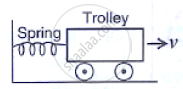
A spring is kept compressed by a small trolley of mass 0.5 kg lying on a smooth horizontal surface as shown in the adjacent fig. When the trolley is released, it is found to move at a speed v = 2 m s-1. What potential energy did the spring possess when compressed?
Is potential energy a vector or a scalar quantity?
A boy weighing 50 kg climbs up a vertical height of 100 m. Calculate the amount of work done by him. How much potential energy does he gain? (g = 9.8 m/s2)
A body of mass 2 kg is thrown vertically upwards with an initial velocity of 20 m/s. What will be its potential energy at the end of 2 s? (Assume g = 10 m/s2).
If 784 J of work was done in lifting a 20 kg mass, calculate the height through which it was lifted. (g = 9.8 m/s2)
A man is instructed to carry a package from the base camp at B to summit A of a hill at a height of 1200 metres. The man weighs 800 N and the package weighs 200 N. If g = 10 m/s2,
- how much work does man do against gravity?
- what is the potential energy of the package at A if its is assumed to be zero at B?
What energy is possessed by stretched rubber?
The potential energy is
