Advertisements
Advertisements
प्रश्न
Prove that the kinetic energy of a freely falling object on reaching the ground is nothing but the transformation of its initial potential energy.
Advertisements
उत्तर
Let the object be at point A i.e. at height h above the surface of Earth as shown in the figure below.

At point A
The object is stationary i.e. its initial velocity, u = 0.
Kinetic energy, `K = 1/2mv^2 = 1/2m u^2 = 0`
Potential energy, U = mgh ...... (i)
At point B
Let the velocity of the object be vB and the object has fallen through distance x.
Using the third equation of motion, we have
`v_B^2 = 0 + 2gx`
⇒ `v_B^2 = 2gx`
Kinetic energy , `K = 1/2mv_B^2 = mgx`
Potential energy , U = mg(h-x) ....(ii)
At point C
Let the velocity of the object be vC and the object has fallen through a distance h.
Using the third equation of motion, we have
`v_C^2 = 0 + 2gh`
⇒ `v_B^2 = 2gh`
Kinetic energy, `K = 1/2 mv_C^2 = mgh` ....(iii)
Potential energy, U = 0
From (i) and (iii), we see that the Potential energy of the object at point A has transformed into its kinetic energy at point C. Thus, it can be concluded that the kinetic energy of a freely falling object reaching the ground is nothing but the transformation of its initial potential energy.
APPEARS IN
संबंधित प्रश्न
State two factors on which the potential energy of a body at a certain height above the ground depends.
Two bodies A and B of masses 10 kg and 20 kg respectively are at the same height above the ground. Which of the two has greater potential energy?
Write the expression for the gravitational potential energy explaining the meaning of the symbols used.
Find the gravitational potential energy of 2.5 kg mass kept at a height of 15 m above the ground. The force of gravity on mass 1 kg is 10 n.
Define the term potential energy of a body.
The potential energy of a body is the energy by virtue of its ______.
A body at a height possesses ______.
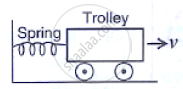
A spring is kept compressed by a small trolley of mass 0.5 kg lying on a smooth horizontal surface as shown in the adjacent fig. When the trolley is released, it is found to move at a speed v = 2 m s-1. What potential energy did the spring possess when compressed?
Is potential energy a vector or a scalar quantity?
State whether the following statement is true or false :
The potential energy of a body of mass 1 kg kept at a height of 1 m is 1 J.
A weightlifter is lifting weights of mass 200 kg up to a height of 2 metres. If g = 9.8 m s−2, calculate :
potential energy acquired by the weights.
A weightlifter is lifting weights of mass 200 kg up to a height of 2 metres. If g = 9.8 m s−2, calculate :
work done by the weightlifter
To what height should a box of mass 150 kg be lifted, so that its potential energy may become 7350 joules? (g = 9.8 m/s2)
Give one example each of a body possessing : (i) kinetic energy, and (ii) potential energy.
If 784 J of work was done in lifting a 20 kg mass, calculate the height through which it was lifted. (g = 9.8 m/s2)
When a ball is thrown vertically upwards, its velocity goes on decreasing. What happens to its potential energy as its velocity becomes zero?
A car is accelerated on a levelled road and acquires a velocity 4 times of its initial velocity. During this process, the potential energy of the car :
The energy, possessed by an object due to its position is called ______.
