Advertisements
Advertisements
प्रश्न
If 784 J of work was done in lifting a 20 kg mass, calculate the height through which it was lifted. (g = 9.8 m/s2)
Advertisements
उत्तर
Mass of the box (m) = 20 kg
Acceleration due to gravity (g) = 9.8 m/s2
Work done against gravity (W) = 784 J
Let the height above the ground be (h)
So, W = m × g × h
So, height can be calculated as,
`h = W/(m xx g)`
So ,
`h = 784/(20 xx 9.8) m`
= `784/196 m`
= 4 m
So the body is lifted to a height of 4 m.
APPEARS IN
संबंधित प्रश्न
Two bodies A and B of masses 10 kg and 20 kg respectively are at the same height above the ground. Which of the two has greater potential energy?
Define the term potential energy of a body.
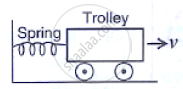
A spring is kept compressed by a small trolley of mass 0.5 kg lying on a smooth horizontal surface as shown in the adjacent fig. When the trolley is released, it is found to move at a speed v = 2 m s-1. What potential energy did the spring possess when compressed?
State whether the following statement is true or false :
The potential energy of a body of mass 1 kg kept at a height of 1 m is 1 J.
A weightlifter is lifting weights of mass 200 kg up to a height of 2 metres. If g = 9.8 m s−2, calculate :
work done by the weightlifter
A man is instructed to carry a package from the base camp at B to summit A of a hill at a height of 1200 metres. The man weighs 800 N and the package weighs 200 N. If g = 10 m/s2,
- how much work does man do against gravity?
- what is the potential energy of the package at A if its is assumed to be zero at B?
Which of the following is the example potential energy?
What energy is possessed by stretched rubber?
A body is falling from a height of h. After it has fallen a height `"h"/2`, it will possess
The potential energy is
