Advertisements
Advertisements
Question
If 784 J of work was done in lifting a 20 kg mass, calculate the height through which it was lifted. (g = 9.8 m/s2)
Advertisements
Solution
Mass of the box (m) = 20 kg
Acceleration due to gravity (g) = 9.8 m/s2
Work done against gravity (W) = 784 J
Let the height above the ground be (h)
So, W = m × g × h
So, height can be calculated as,
`h = W/(m xx g)`
So ,
`h = 784/(20 xx 9.8) m`
= `784/196 m`
= 4 m
So the body is lifted to a height of 4 m.
APPEARS IN
RELATED QUESTIONS
The potential energy of a freely falling object decreases progressively. Does this violate the law of conservation of energy? Why?
Write the expression for the gravitational potential energy explaining the meaning of the symbols used.
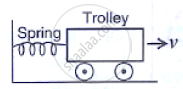
A spring is kept compressed by a small trolley of mass 0.5 kg lying on a smooth horizontal surface as shown in the adjacent fig. When the trolley is released, it is found to move at a speed v = 2 m s-1. What potential energy did the spring possess when compressed?
A ball of mass m is thrown vertically up with an initial velocity so as to reach a height h. The correct statement is:
Two bodies A and B of equal masses are kept at heights of h and 2h respectively. What will be the ratio of their potential energies?
Prove that the kinetic energy of a freely falling object on reaching the ground is nothing but the transformation of its initial potential energy.
If we increase the velocity of a car moving on a flat surface to four times its original speed, its potential energy ______.
The potential energy of your body is least when you are ______.
How much energy is gained by a box of mass 20 kg when a man, raises the box by 0.5 m in order to place it inside the bus? (g=10 m/s-2)
The potential energy is
