Advertisements
Advertisements
Question
What is the difference between gravitational potential energy and elastic potential energy? Give one example of a body having gravitational potential energy and another having elastic potential energy.
Advertisements
Solution
We can differentiate between gravitational and elastic potential energy as -
| Gravitational potential energy | Elastic potential energy |
| A body possesses gravitational potential energy if it is placed any height above the ground. (ground is considered as the refence level) | A body possesses elastic potential energy if its shape is changed by squeezing, pushing or pulling. |
| Gravitational force is responsible for this energy. | Elastic property of the body is responsible for this energy. |
Example:
(i) Gravitational potential energy - A book kept on a table possesses gravitational potential energy because of its position above the ground.
(ii) Elastic potential energy - The stretched rubber string of a catapult possesses elastic potential energy because of the change in shape of the string.
APPEARS IN
RELATED QUESTIONS
Gravitational potential energy U = mass × force of gravity on unit mass × ..........
Define the term potential energy of a body.
The potential energy of a body is the energy by virtue of its ______.
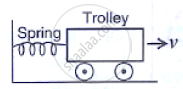
A spring is kept compressed by a small trolley of mass 0.5 kg lying on a smooth horizontal surface as shown in the adjacent fig. When the trolley is released, it is found to move at a speed v = 2 m s-1. What potential energy did the spring possess when compressed?
Is potential energy a vector or a scalar quantity?
State whether the following statement is true or false :
The potential energy of a body of mass 1 kg kept at a height of 1 m is 1 J.
On what factors does the gravitational potential energy of a body depend?
The energy, possessed by an object due to its position is called ______.
What energy is possessed by stretched rubber?
The potential energy is
