Advertisements
Advertisements
Question
A ball of mass m is thrown vertically up with an initial velocity so as to reach a height h. The correct statement is:
Options
Potential energy of the ball at the ground is mgh.
Kinetic energy to the ball at the ground is zero.
Kinetic energy of the ball at the highest point is mgh.
Potential energy of the ball at the highest point is mgh.
Advertisements
Solution
Potential energy of the ball at the highest point is mgh.
Explanation:
At the highest point, the ball momentarily comes to rest, and thus its kinetic energy becomes zero.
APPEARS IN
RELATED QUESTIONS
A bucket full of water is on the first floor of your house and another identical bucket with the same quantity of water is kept on the second floor. Which of the two has greater potential energy?
A body of mass m is moved from ground to a height h. If the force of gravity on mass of 1 kg is g newton, find the force needed to lift the body.
The potential energy of a body is the energy by virtue of its ______.
A body at a height possesses ______.
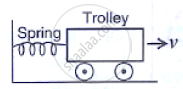
A spring is kept compressed by a small trolley of mass 0.5 kg lying on a smooth horizontal surface as shown in the adjacent fig. When the trolley is released, it is found to move at a speed v = 2 m s-1. What potential energy did the spring possess when compressed?
A body falls freely under gravity from rest. Name the kind of energy it will possess at the point from where it falls.
If 784 J of work was done in lifting a 20 kg mass, calculate the height through which it was lifted. (g = 9.8 m/s2)
Prove that the kinetic energy of a freely falling object on reaching the ground is nothing but the transformation of its initial potential energy.
The energy, possessed by an object due to its position is called ______.
The potential energy is
