Advertisements
Advertisements
प्रश्न
A ball of mass m is thrown vertically up with an initial velocity so as to reach a height h. The correct statement is:
विकल्प
Potential energy of the ball at the ground is mgh.
Kinetic energy to the ball at the ground is zero.
Kinetic energy of the ball at the highest point is mgh.
Potential energy of the ball at the highest point is mgh.
Advertisements
उत्तर
Potential energy of the ball at the highest point is mgh.
Explanation:
At the highest point, the ball momentarily comes to rest, and thus its kinetic energy becomes zero.
APPEARS IN
संबंधित प्रश्न
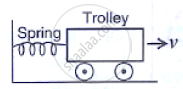
A spring is kept compressed by a small trolley of mass 0.5 kg lying on a smooth horizontal surface as shown in the adjacent fig. When the trolley is released, it is found to move at a speed v = 2 m s-1. What potential energy did the spring possess when compressed?
Is potential energy a vector or a scalar quantity?
State whether the following statement is true or false :
The potential energy of a body of mass 1 kg kept at a height of 1 m is 1 J.
A weightlifter is lifting weights of mass 200 kg up to a height of 2 metres. If g = 9.8 m s−2, calculate :
work done by the weightlifter
On what factors does the gravitational potential energy of a body depend?
Explain by an example what is meant by potential energy. Write down the expression for gravitational potential energy of a body of mass m placed at a height h above the surface of the earth.
If 784 J of work was done in lifting a 20 kg mass, calculate the height through which it was lifted. (g = 9.8 m/s2)
When a ball is thrown vertically upwards, its velocity goes on decreasing. What happens to its potential energy as its velocity becomes zero?
The energy, possessed by an object due to its position is called ______.
A body is falling from a height of h. After it has fallen a height `"h"/2`, it will possess
