Advertisements
Advertisements
प्रश्न
Explain by an example what is meant by potential energy. Write down the expression for gravitational potential energy of a body of mass m placed at a height h above the surface of the earth.
Advertisements
उत्तर
An example to explain the fundamental meaning of potential energy is as follows:
A brick lying on the ground has no energy, so it cannot do any work. If we lift the brick to the roof of a house, the work done in lifting the brick against gravity gets stored in it in the form of potential energy. Thus, the energy in the brick is due to its higher position with respect to the ground, which is known as potential energy.
We can calculate the potential energy of a body of mass (m) lifted by a height (h) as,
Potential energy = (Weight of body) × (Vertical distance)
So,
P.E = m × g × h
Where,
(P.E) - Potential energy
(m) - Mass of body
(g) - Acceleration due to gravity
(h) - Height by which the body is lifted
APPEARS IN
संबंधित प्रश्न
The potential energy of a freely falling object decreases progressively. Does this violate the law of conservation of energy? Why?
Define the term potential energy of a body.
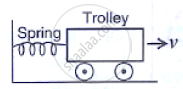
A spring is kept compressed by a small trolley of mass 0.5 kg lying on a smooth horizontal surface as shown in the adjacent fig. When the trolley is released, it is found to move at a speed v = 2 m s-1. What potential energy did the spring possess when compressed?
A body falls freely under gravity from rest. Name the kind of energy it will possess at the point from where it falls.
What happens to the potential energy of a body when its height is doubled?
To what height should a box of mass 150 kg be lifted, so that its potential energy may become 7350 joules? (g = 9.8 m/s2)
On what factors does the gravitational potential energy of a body depend?
Prove that the kinetic energy of a freely falling object on reaching the ground is nothing but the transformation of its initial potential energy.
How much energy is gained by a box of mass 20 kg when a man, raises the box by 0.5 m in order to place it inside the bus? (g=10 m/s-2)
Which of the following is the example potential energy?
